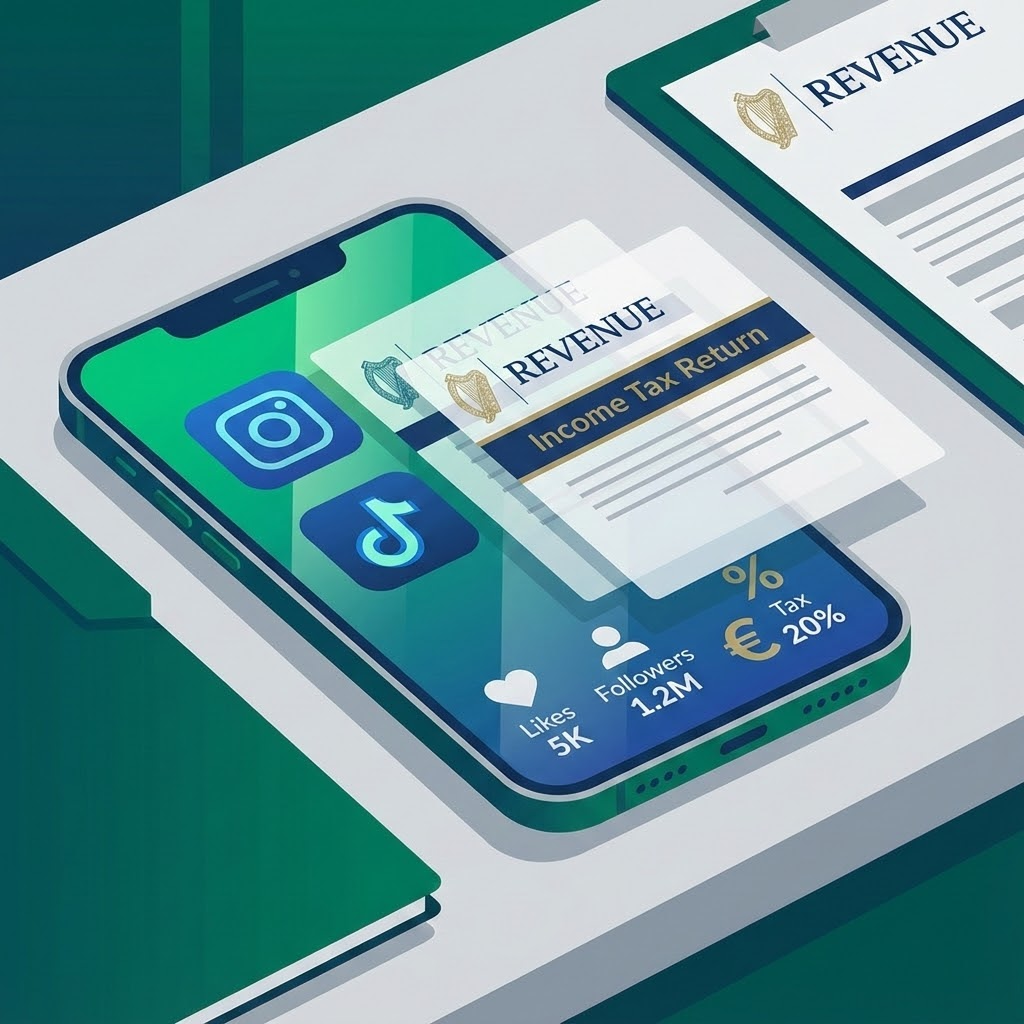
Ireland's Revenue Commissioners have issued a stark warning to the country's social media influencers: all income-generating activity on digital platforms is taxable, and tax authorities are watching closely.
"If you're doing it, we will know about it," declared Revenue chairman Niall Cody, as the agency released new guidance making clear that even gifts and freebies received in exchange for promotion carry tax implications.
The warning comes as Revenue audits covering the period from 2020 to 2024 reveal that approximately €3.3 million in outstanding tax is owed by Ireland's influencers, content creators, and social media personalities . Prominent names have already begun appearing on the tax defaulters' list, signaling a new era of enforcement in the digital economy.
High-Profile Tax Settlements Among those who have settled with Revenue is Matthew Gilbert , known online as "The Irish Viking," an OnlyFans content creator who revealed in a 2021 interview that he was earning more than €54,000 per month on the adult subscription service. Gilbert made tax settlements with Revenue totaling more than €350,000 at the end of last year.
The tax agency's increased scrutiny has made many in the influencer community reluctant to discuss their tax affairs publicly. One social media personality with millions of followers declined to comment on the new guidelines, saying only: "I still have to get my head around them myself."
What the New Guidance Covers Revenue's latest guidance establishes that all social media income-generating activity is taxable, regardless of whether it is conducted on a full-time or casual basis. This includes:
Social media promotions Advertising collaborations Brand partnerships Gifts and freebies received in exchange for promotion The comprehensive approach reflects how brands have shifted their marketing strategies toward influencer partnerships as traditional advertising models have declined. A well-placed collaboration or endorsement can now put millions of eyeballs on products, creating significant commercial value.
Tax Thresholds and Requirements Dublin-based tax adviser Enda Callan reports that confusion about the rules remains widespread among content creators.
"There's been a few content creators knocking on the door recently, and a lot of them don't understand what's required," Callan said. "Revenue is getting a lot better lately at tracking social media."
According to Callan, even small earnings must be declared:
Under €5,000 annually : Must be declared on Form 12 PAYE return (common misconception that amounts below €5,000 are not taxable)Over €5,000 annually : Must register as self-employed and submit Form 11 income tax return by October 31st the following yearOver €42,500 annually : VAT registration becomes mandatoryThe Barter Economy: Gifts and Freebies One of the most significant areas of confusion involves non-cash compensation. Many influencers are unaware that complimentary hotel stays, free products, or services received in exchange for promotion are considered taxable income.
"Say a hotel down in Galway says you can come down for two nights – 'We won't charge you, but you agree to do a video on it' – many would think it is tax-free," Callan explained. "But where goods or services are provided in exchange for promotion, Revenue would generally expect the value received to be treated as taxable income."
Thalia O'Toole , tax principal at KPMG, noted that Revenue's focus on barter arrangements follows enhanced awareness across the media industry.
"They are interested in the free use of goods, like cars, where you turn up at an event or where you receive a free product or service and you review it, effectively an exchange for that product," O'Toole said. "It's one of two things: either you aren't doing anything in exchange for something and it's deemed to be a gift – and gift tax could then apply to it – or you are performing a service in exchange for its receipt, and it's likely to be taxable trading income."
Is that "Free" Hotel Stay Taxable?
Yes. If you receive a hotel stay, car rental, or product in exchange for a post, Revenue counts the market value of that item as taxable income.
Example: A €500 hotel stay = €500 taxable income.
Why Revenue Can Track Influencer Activity John Galligan , tax director at KPMG, explained that the public nature of social media makes enforcement relatively straightforward.
"Revenue have always utilised information provided by the public as a tool to tackle tax evasion, but you are now in a new world where people are showcasing their level of activity directly to Revenue through their online presence," Galligan said.
According to Galligan, Revenue began taking influencer earnings more seriously in 2023, and the issuing of detailed manuals over the summer suggests the agency has dedicated teams monitoring online activity.
Structuring for High Earners For influencers generating substantial income, Callan advises considering company formation for tax efficiency.
"Once you are earning more than you need to survive, over and above the amount needed to pay the mortgage, car loan, living expenses etc, it would make sense to form a limited company and leave this money in the company to be taxed at 12.5 per cent, rather than at the marginal tax rate for a sole trader ," he said.
Using a hypothetical example of a creator making €200,000 profit, Callan suggested taking €70,000 to €80,000 as salary, with the balance remaining in the company and taxed at the lower corporate rate rather than the higher personal income tax rate.
Avoiding the Tax Defaulters' List Tax advisers emphasize that transparency and cooperation with Revenue can help influencers avoid the worst outcomes, including publication on the defaulters' list.
Galligan explained that when Revenue makes initial contact, "They may still pay a penalty, but it would depend on the level of default."
O'Toole added: "If you are talking about someone who has been careless in their tax-compliance obligations, is fully co-operating with Revenue and the penalty rate agreed with Revenue is below 15 per cent, you would generally avoid the defaulters' list in those circumstances. However, deliberate non-compliant behaviour, the size of the settlement or poor co-operation levels can lead to larger penalties being levied, and that could land you in publication territory."
A Revenue spokesperson emphasized the agency's educational approach: "Most creators want to get things right. Revenue's approach in this area is focused on supporting voluntary compliance. Engagement with creators typically begins with education and guidance, with risk-based compliance interventions applied where necessary."
Advertising Disclosure Requirements Beyond tax compliance, influencers must also contend with advertising disclosure rules enforced by the Competition and Consumer Protection Commission (CCPC) .
Former Irish rugby international Brian O'Driscoll was found to have "engaged in a misleading commercial practice" after the CCPC examined an Instagram post connected with the Zerofit clothes range. He was directed to ensure that all paid promotions are clearly labeled as such.
Fitness coach Caroline O'Mahony , who has more than 800,000 Instagram followers, was similarly found to have failed to use appropriate labels to disclose the commercial nature of content related to her fitness business.
The CCPC has written to 26 influencers reminding them of their obligations under consumer protection law.
Conclusion What began for many as a novel way to earn supplementary income has evolved into a heavily regulated activity requiring careful attention to both tax and consumer protection compliance. With Revenue monitoring online activity, issuing detailed guidance, and conducting audits that have uncovered millions in unpaid taxes, Ireland's influencers face a new reality: their digital earnings are under the same scrutiny as any traditional business income.
Tax experts advise that the best approach is proactive compliance, proper record-keeping, and seeking professional advice when earnings reach significant levels. As one tax adviser put it, what may have started as fun now looks "a lot like old-fashioned hard work."