Irish founders deciding between IPOI national registration and EU-wide EUTM protection for their brands will find this analysis essential for timing and budget decisions.
Read this to understand the cost, coverage differences and staged filing approach that balances early protection with future EU expansion needs.
Key Takeaways
- The IPOI route remains cheapest, fastest and lowest-risk for Ireland-focused brands at €247 for single class.
- EUTM provides unitary protection across all 27 EU states but carries all-or-nothing opposition risk.
- Staged filing lets startups secure an Irish right early then expand to EUTM using priority claims.
- Pricing favors EUTM once three or more classes are needed or EU-wide coverage is required.

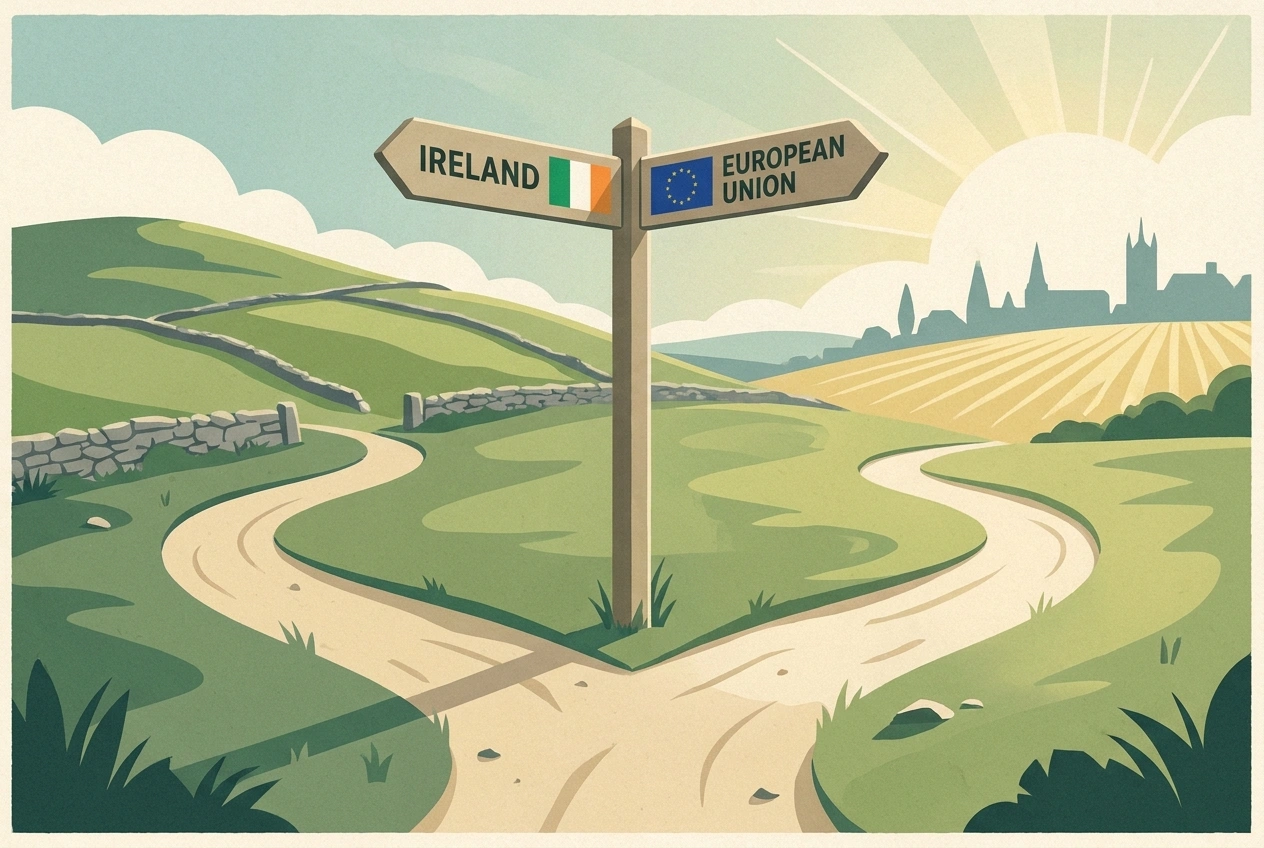
Most Irish founders meet the same fork in the road: register the trade mark with the Intellectual Property Office of Ireland (IPOI) for €70, or file an EU trade mark (EUTM) with the EUIPO for €850 and cover all 27 member states in one go. The EU trade mark vs Irish trade mark choice looks like a simple cost calculation, but the right answer turns on where your customers actually are, what your opposition risk looks like, and how much downside you can absorb if the application is blocked. This article walks through the trade-offs so you can pick the right route for your stage and protect the goodwill you have already built.
The basic distinction
An Irish national trade mark is granted by the IPOI and is valid in Ireland only. An EU trade mark is granted by the EUIPO in Alicante and is a unitary right valid across all 27 EU member states, including Ireland, from a single application. Both run for 10 years from filing and renew indefinitely. Both systems operate primarily on a first-to-file basis, although earlier unregistered rights and passing off claims may still affect later applications or registrations in some circumstances. The substantive standards (distinctiveness, descriptiveness, conflict with earlier rights) are closely aligned because Irish trade mark law was harmonised with EU law decades ago.
That harmonisation matters because a mark refused on absolute grounds at IPOI is likely to face similar issues at EUIPO, and EUIPO examiners often apply those substantive standards more strictly.
Cost and timing side-by-side
The headline numbers as of May 2026:
Application fees:
- IPOI: €70 first class, €70 each additional class, plus a €177 registration fee on grant
- EUIPO: €850 first class, €50 second class, €150 each from the third, no separate registration fee
Typical time to registration:
- IPOI: 8 to 12 months with no opposition
- EUIPO: 4 to 6 months with no opposition
Opposition window:
- IPOI: 3 months from publication, no extensions
- EUIPO: 3 months from publication, no extensions
Renewal every 10 years:
- IPOI: €250 plus €125 per extra class
- EUIPO: €850 base, with €50/€150 per extra class
For a single-class filing the total Irish cost lands at roughly €247 and the EUTM at €850, a gap that closes as you add classes. From around three classes the EUTM becomes roughly comparable on price, and from four or five classes it is the cheaper option for the same scope.
Author's tip: Do the maths against your actual class count, not the rule of thumb. The EUTM is rarely the cheapest answer for a one- or two-class brand staying in Ireland.
Coverage and the all-or-nothing risk
The EUTM is a unitary right. That is its strength and its weakness. A single, properly accepted EUTM blocks competitors across 449 million consumers accross the EU single market. But the same unity means a single successful opposition from any one EU country can sink the application in all 27. The risk is not theoretical: EUTM applications are regularly opposed, particularly for commercially attractive brands.
If a prior right exists in, say, France or Germany, your EUTM can be blocked even if Irish trade is your only commercial focus. Although an EUTM can be limited or partially revoked in relation to specific goods or services, a successful opposition or invalidity based on earlier rights in any one member state can still affect the validity of the mark across the EU.
The Irish national mark has no such cross-border exposure. The downside is the matching limit: it gives you nothing outside the State. Common-law passing-off claims can stretch a little further where reputation crosses borders, but they are expensive and unpredictable to rely on.
When the Irish national mark wins
File the Irish mark first if any of these apply:
- Your customers and revenue are concentrated in Ireland for the next two to three years
- You have a tight launch budget and need to register the brand cheaply before marketing spend
- You suspect a clearance conflict in continental Europe but not in Ireland
- The mark is borderline distinctive and an Irish examiner is more likely to accept it than a stricter EUIPO examiner
- You intend to use the registered Irish right later as a basis for an international application through the Madrid Protocol
The Irish route also tends to be faster to a defensible enforcement position. A registered Irish mark and a documented due diligence pack for your first funding round is usually enough to satisfy seed investors that the brand sits on solid ground.
When the EUTM wins
File the EUTM if any of these apply:
- You are selling, or will sell, in multiple EU countries within 18 months
- You raise from EU investors who expect EU-wide brand protection at term sheet stage
- Your product class count is three or more, where EUTM pricing becomes competitive
- The mark is strong and distinctive, so opposition risk is genuinely low
- You licence the brand to partners across the EU, and need a single enforcement vehicle backed by limitation of liability caps and an indemnity framework that travels with the right
The EUTM is also commonly used by Irish IP holding companies where trade marks sit alongside other qualifying IP assets (such as patented or software-related IP that may benefit from the Knowledge Development Box regime).
Strategy for staged filing
A pragmatic strategy for many Irish startups is a two-step approach:
- File the Irish mark immediately on incorporation. Cost is low, opposition risk is low, and you secure the right at home.
- File the EUTM (or designate the EU under Madrid) when you are within six months of a real EU launch, or when you have raised the next round. Use the Irish application date as a priority claim within the six-month Paris Convention window so the EUTM inherits the earlier date.
This sequencing keeps the cheap and reliable Irish right always live, while leaving the larger EUTM spend until you actually need EU-wide coverage. It also separates risk: a problem with the EUTM later does not undo the Irish registration.
For licensing across borders, build in an arbitration clause so disputes do not default to whichever court the infringer prefers. In our experience, brand licensing is one of the few areas where a clean arbitration route is consistently faster than national courts.
Wrapping up
The EU trade mark vs Irish trade mark decision is genuinely strategic, not just procedural. As of May 2026, the IPOI national route remains the cheapest, fastest and lowest-risk option for an Ireland-focused brand, and the EUTM is the right call once your customers, investors or licensing footprint actually need EU-wide protection. The staged filing approach is often the cleanest way to get both, in sequence, without overspending early. Open Forest can run the choice and the paperwork for your next launch.

Laura Ryan is a practising Barrister at the Bar of Ireland. She graduated from the Honourable Society of King’s Inns in 2024, having previously qualified and practised as a Chartered Accountant in a big four accounting firm.

%20(1).webp)


.webp)