Irish small employers, startups, and HR managers hiring new staff who need to navigate probation compliance.
They'll learn how to structure 6-month probations, draft enforceable clauses, conduct reviews, handle underperformance, and avoid common pitfalls leading to Workplace Relations Commission claims.
Key Takeaways
- Probation periods capped at 6 months since August 2022 under EU Regulations; extensions only exceptional and written.
- Suspends during protected leaves like maternity or sick leave.
- Draft clauses with specific duration, criteria, notice, extensions; benefits accrue by statute.
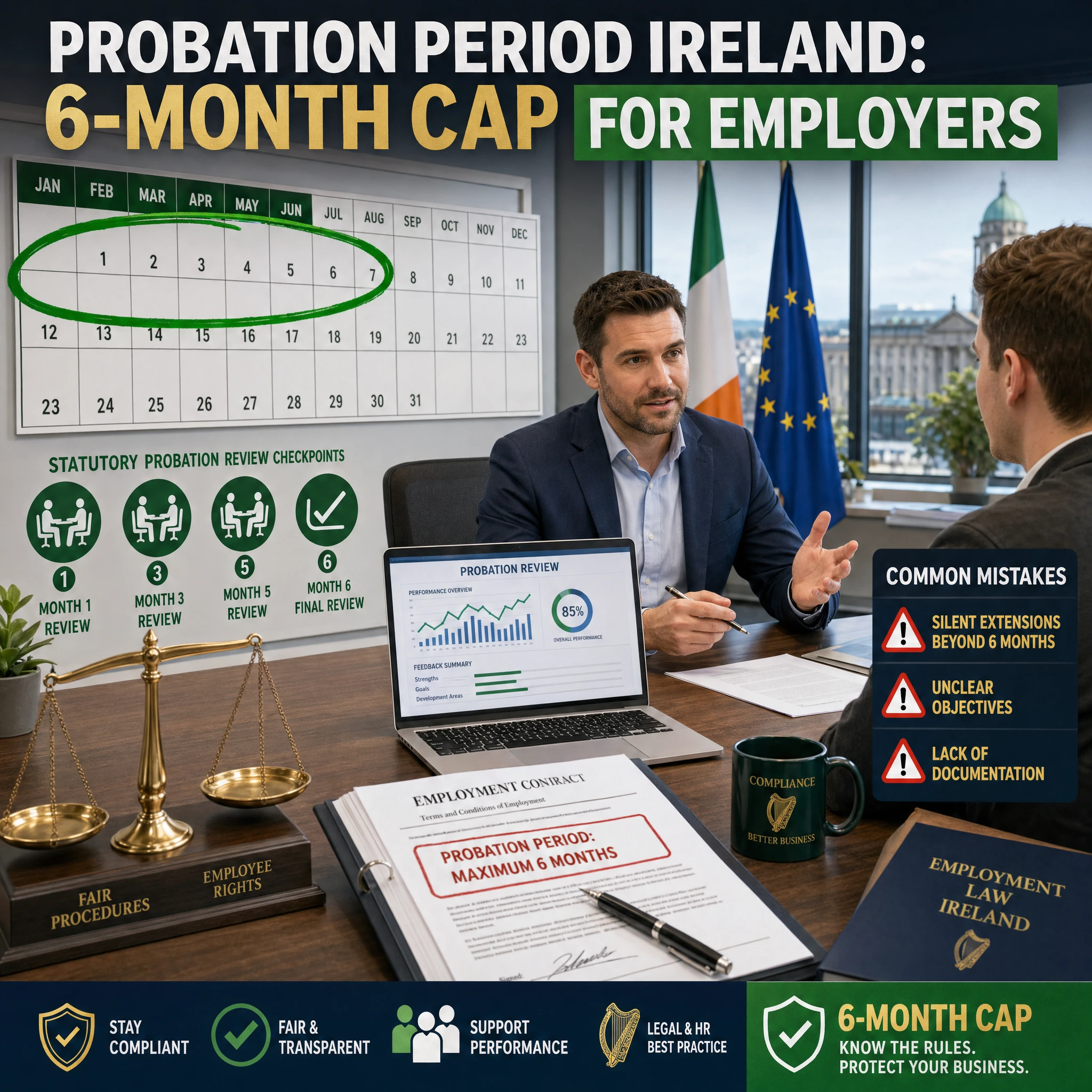
- Run structured reviews at months 1,3,5,6 with full documentation.
- Fair dismissal procedures required for misconduct or protected rights to avoid WRC claims.

Before 2022, probation in Ireland was mostly a contract question, not a legal one. That changed when the EU Transparent and Predictable Working Conditions Regulations took effect on 1 August 2022, capping a probation period in Ireland at six months. For small employers, that shift turned probation from a loose review window into a structured legal framework with real documentation duties. This guide covers what the 6-month cap means in practice, when you can extend, how to run reviews, and what to do if a probationary employee is not working out. As of April 2026, the rules described below remain in force under S.I. 686/2022.
What does probation mean under Irish employment law?
A probation period is a defined window at the start of employment during which the employer assesses an employee's suitability for the role, now limited to six months by statute. Before the 2022 Regulations, probation sat entirely in the contract. The Regulations (which transpose EU Directive 2019/1152) amended the Terms of Employment (Information) Acts and put statutory limits on both the length and use of probation.
The change matters for three reasons. First, you cannot quietly run a 12-month probation any more, you need a specific reason. Second, probation now has to be suspended during protected leave (maternity, paternity, adoptive, parental, carer's, and sick leave). Third, unfair dismissal law still applies to probationary employees in specific situations, so "no rights during probation" is a myth that will cost you at the Workplace Relations Commission.
How long can a probation period in Ireland last?
The standard maximum probation period in Ireland is six months, with an extension to 12 months only in exceptional circumstances. The Regulations are specific: any extension must be on an exceptional basis and must be in the interest of the employee. Typical examples include an employee returning from long-term sick leave, or a role where the nature of the work genuinely requires more time to assess, such as highly specialised technical positions.
A few practical points to get right:
- Fixed-term contracts must have a proportionate probation. A 9-month fixed-term contract cannot carry a 6-month probation; it would swallow the contract.
- Public service employees can have a 12-month probation by default.
- Any extension needs to be justified in writing and agreed with the employee. Silent extensions are non-compliant and expose you to a Workplace Relations Commission claim worth up to four weeks' remuneration.
That covers the headline rule. The next question is how to make the clause itself enforceable.
How should you draft the probation clause?
A compliant probation clause sets out start and end dates, performance standards, notice during probation, and the procedure for any extension. If any of those are missing, the clause will not hold up under scrutiny.
The clause should cover the following:
- Duration and end date. Specify the exact number of months and, where possible, the calendar end date.
- Performance criteria. Tie the review to concrete standards the employee can understand, not "general suitability".
- Notice during probation. State what notice applies inside probation (often one week) and what applies after.
- Extension mechanism. Spell out that probation can be extended only in specific circumstances, with reasons confirmed in writing.
- Benefits and leave. Clarify how annual leave and other benefits accrue during probation. They do accrue: accrual is set by statute, not by the employer.
Author's tip: Do not copy a UK probation clause into an Irish contract. UK rules allow a 2-year service threshold for unfair dismissal and different probation norms. Irish law is tighter and more employee-protective.
How do you run a probation review properly?
A probation review is a structured check-in where the employer gives written feedback, flags any concerns, and formally confirms, extends, or ends the probation. Informal "how is it going?" chats are not reviews in the legal sense.
A workable cadence for a six-month probation is:
- Month 1: onboarding check-in (30 minutes, informal but noted).
- Month 3: mid-probation review with written feedback.
- Month 5: pre-completion review. Decide pass, extend, or terminate.
- Month 6: written confirmation that probation has been successfully completed, or a formal extension letter.
Keep every document: agendas, feedback forms, emails, and signed confirmations. These records are the difference between a defensible decision and a WRC award against you. Our guide to document retention for Irish companies covers how long to hold HR files and in what format.
With reviews on the calendar, the harder conversation is what happens when an employee is not working out.
Can you dismiss an employee during probation?
Yes, but fair procedures still apply in specific circumstances, even during probation. The Unfair Dismissals Act 1977 generally requires 12 months' continuous service, which means most probationary employees cannot bring a standard unfair dismissal claim. That is where most employers stop reading, and where most of them get into trouble.
Three things can still be challenged:
- Dismissal for misconduct. The High Court was clear in Buttimer v Oak Fuel Supermarket Ltd [2023] IEHC 126: if you dismiss for misconduct, you must follow fair procedures and natural justice. That means putting allegations in writing, allowing a response, and giving a right to appeal. Your small-employer grievance procedure should feed directly into this.
- Section 20(1) Industrial Relations Act 1969. An employee with under 12 months' service can still refer a dispute to the Labour Court under this section. Recommendations are not legally binding, but they are public and reputational.
- Automatic exceptions. Dismissal connected to pregnancy, trade union activity, or exercising statutory leave rights gives the employee immediate access to the Unfair Dismissals Acts, regardless of service length.
Recent WRC decisions have awarded significant compensation where probationary dismissals were handled without fair procedures, including awards well into five figures. The lesson is not "never dismiss during probation", it is "dismiss properly".
Get your probation framework right before your next hire Open Forest reviews employment contracts, probation clauses, and review templates for Irish small employers, so you can manage probation confidently without exposing the business to WRC claims. Book a contract review.
What probation mistakes do Irish startups make most often?
The most common failures are silent extensions, skipped reviews, and copy-pasted UK clauses. Each one creates a distinct risk profile.
- Silent extensions. Letting the 6-month date pass without written confirmation. The employee now has confirmed employment, and the probation argument is gone.
- Skipped reviews. No documented feedback, then a sudden dismissal at month five. Without company records, you cannot show the process was fair or that performance concerns were raised in time.
- UK clauses in Irish contracts. Longer probations, different notice rules, no reference to protected leave suspension. All non-compliant in Ireland.
- No grievance route. If the employee raises a concern during probation, you still need a structured grievance process to handle it.
- Contract vs statute confusion. Contract terms cannot override the 6-month statutory cap. A 12-month non-compete-clause or probation clause is unenforceable beyond month six, except in the limited exceptions above.
Where this leaves you
Probation in Ireland is no longer a handshake arrangement. Since August 2022, it is a six-month window with a narrow extension route, clear documentation duties, and real dismissal risk if you skip fair procedures. We recommend that you treat it like any other compliance process: write the clause properly, schedule the reviews, and keep the paperwork.
If you want a second pair of eyes on your probation clauses and review templates before your next hire, Open Forest can walk through your employment-contract and flag anything the Workplace Relations Commission would challenge.

Laura Ryan is a practising Barrister at the Bar of Ireland. She graduated from the Honourable Society of King’s Inns in 2024, having previously qualified and practised as a Chartered Accountant in a big four accounting firm.