This article is for Irish SaaS founders, startup CEOs, and in‑house legal counsel who need to navigate AI intellectual‑property issues in 2026. It is especially relevant if you are drafting or updating contracts for AI‑enabled products and must comply with Irish law and the EU AI Act.
After reading, you will understand how Irish copyright treats computer‑generated works, what the EU AI Act requires, and which contract clauses you should include to allocate output ownership, warranties, and liability. You will be able to draft practical AI‑specific provisions and assess data‑training risks for your SaaS business.
Key Takeaways
- Irish law names the party arranging a computer‑generated work as author, yet EU law still requires human creativity, meaning AI outputs may lack protection unless contracts specify ownership.
- The EU AI Act, effective August 2026, mandates transparency and documentation for AI systems but does not dictate IP ownership.
- Effective SaaS contracts assign AI output rights to customers, carve out limited rights for aggregated model improvements, and include clear accuracy/disclaimer provisions.
- Indemnity clauses should narrowly cover vendor training‑data IP claims, give customers carve‑outs for prompts, and set a separate liability cap for AI‑related claims.

AI IP Ownership in Ireland: What Founders Need to Know
By Laura · May 2026 · 6 min read
AI is now baked into almost every Irish SaaS product, from autogenerated emails to embedded copilots. The legal question every founder eventually asks is the same: when AI makes something, who owns it? AI IP ownership in Ireland sits at an awkward intersection of old copyright law, new EU rules, and contracts that were never written with generative models in mind.
This guide walks through how Irish and EU law treat AI outputs in 2026, where the real risk lives in your customer contracts, and the clauses your SaaS terms should already have.
Who owns AI-generated outputs under Irish law
Ireland is one of the few EU jurisdictions with an explicit rule on computer-generated works. Section 21(f) of the Copyright and Related Rights Act 2000 (CRRA) says the author of a computer-generated work is the person who made the arrangements necessary for the work to be created. In practice, that points to either the AI tool provider or the user prompting the model, depending on the deployment.
That sounds clean on paper. In reality, courts have not properly tested it on modern generative AI, and the EU is moving in a different direction. The Court of Justice of the EU still requires a human intellectual creation for copyright to attach. So a purely autonomous AI output may have no protection at all under EU-harmonised law, even if Irish law would otherwise recognise it.
The safe operating assumption for AI IP ownership in Ireland is that AI outputs may be unprotected, weakly protected, or owned by your vendor unless your contracts say otherwise.
What the EU AI Act changes from August 2026
The EU AI Act largely applies from 2 August 2026, with obligations phased in before and after that date. It does not assign IP ownership, but it does change what you have to disclose about how AI was built and trained. Providers of general-purpose AI models must meet transparency obligations, including publishing summaries of training data in line with EU guidance and codes of practice. Deployers of high-risk systems must keep technical documentation and log outputs.
Ireland is expected to designate national competent authorities for AI Act enforcement ahead of the main 2026 implementation deadlines. Founders building on top of OpenAI, Anthropic, or open-weights models inherit obligations from those providers, so your contracts need flow-down terms.
Training data and customer prompts
Most of the AI IP ownership questions Irish founders bring to us are not really about outputs. They are about inputs.
Two issues come up repeatedly:
- Training data. If you fine-tune a model on customer data, your customer almost certainly owns that data. Using it to improve a shared model without explicit consent is a GDPR problem before it is an IP problem. Review your GDPR compliance checklist and your vendor data compliance setup before turning fine-tuning on.
- Customer prompts. Prompts often contain confidential information. If your terms allow you to use prompts for training, your enterprise customers will redline you. A clear opt-out and a tight NDA framework is the bare minimum.
What your customer contracts should say about outputs
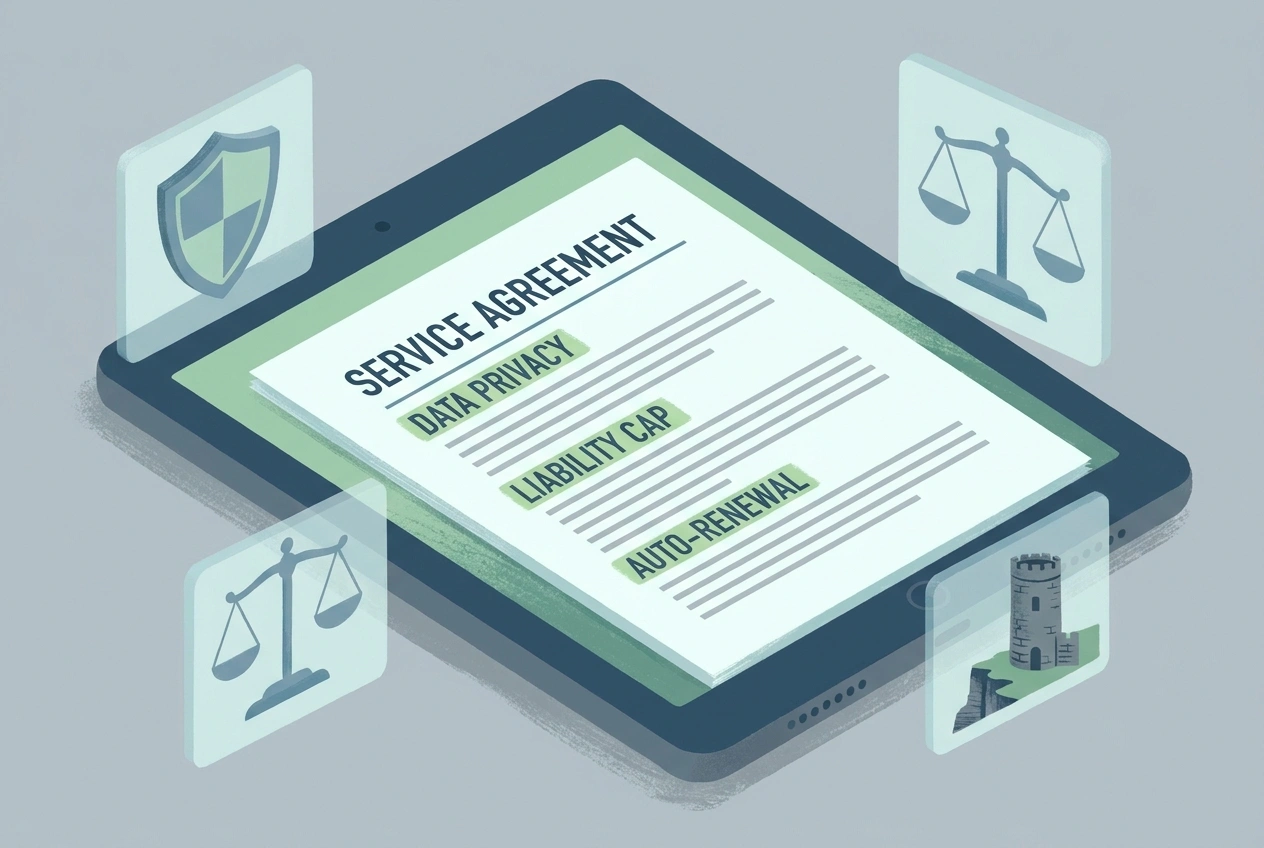
A defensible SaaS contract addresses AI outputs in three places.
- Assignment of outputs to the customer. Where the customer pays for a service and the AI is producing work on their behalf, the cleanest position is to assign all rights, title and interest in outputs to the customer, subject to your retained right to use anonymised data for model improvement.
- Carve-out for shared model improvements. You can keep the right to use aggregated and de-identified data, but never use customer-identifiable content to train models that benefit other customers without explicit consent.
- Accuracy disclaimer. AI hallucinates. Your terms must say that outputs are provided as is, that the customer is responsible for human review, and that automated outputs are not legal, financial or medical advice.
Indemnities and liability for AI outputs
This is where most AI IP ownership in Ireland disputes will land in 2026. Customers want full IP indemnities for any AI output that infringes a third party's rights. Vendors want unlimited carve-outs because they cannot guarantee model behaviour.
A balanced position looks like this:
- A narrow indemnity clause covering third-party IP claims arising from the vendor's own training data choices.
- Customer-side carve-outs for prompts, modifications, and combinations the vendor never approved.
- A limitation of liability that caps AI-related claims separately from the general cap, often at one or two times annual fees.
In our experience, enterprise buyers will push for higher caps. Hold the line on carve-outs for customer inputs because that is the only way to make the indemnity insurable.
Internal IP hygiene before you ship AI features
Before your AI feature ships, the boring stuff has to be in place: founder IP assignment, contractor IP assignment, and clean licensing of any open-source model weights. Read our intellectual property guide for new companies for the assignment templates we use.
If you are training on third-party datasets, we recommend that you document every licence. The EU AI Act's training data transparency rules mean a regulator can ask for that documentation. Companies that built on scraped data without permission are already being challenged in court across the EU.
Where this leaves you
AI IP ownership in Ireland in 2026 is less about who technically owns the output and more about contracts that allocate risk sensibly. Founders who get this right do three things: they assign outputs cleanly to customers, they limit liability with insurable carve-outs, and they keep training data and prompts inside a documented GDPR framework.
The law will keep moving. Your contracts should be specific enough to protect you today and flexible enough to absorb whatever the Irish AI Office and the EU AI Act produce next.

Stuart Connolly is a corporate barrister in Ireland and the UK since 2012.
He spent over a decade at Ireland's top law firms including Arthur Cox & William Fry.

%20(1).webp)