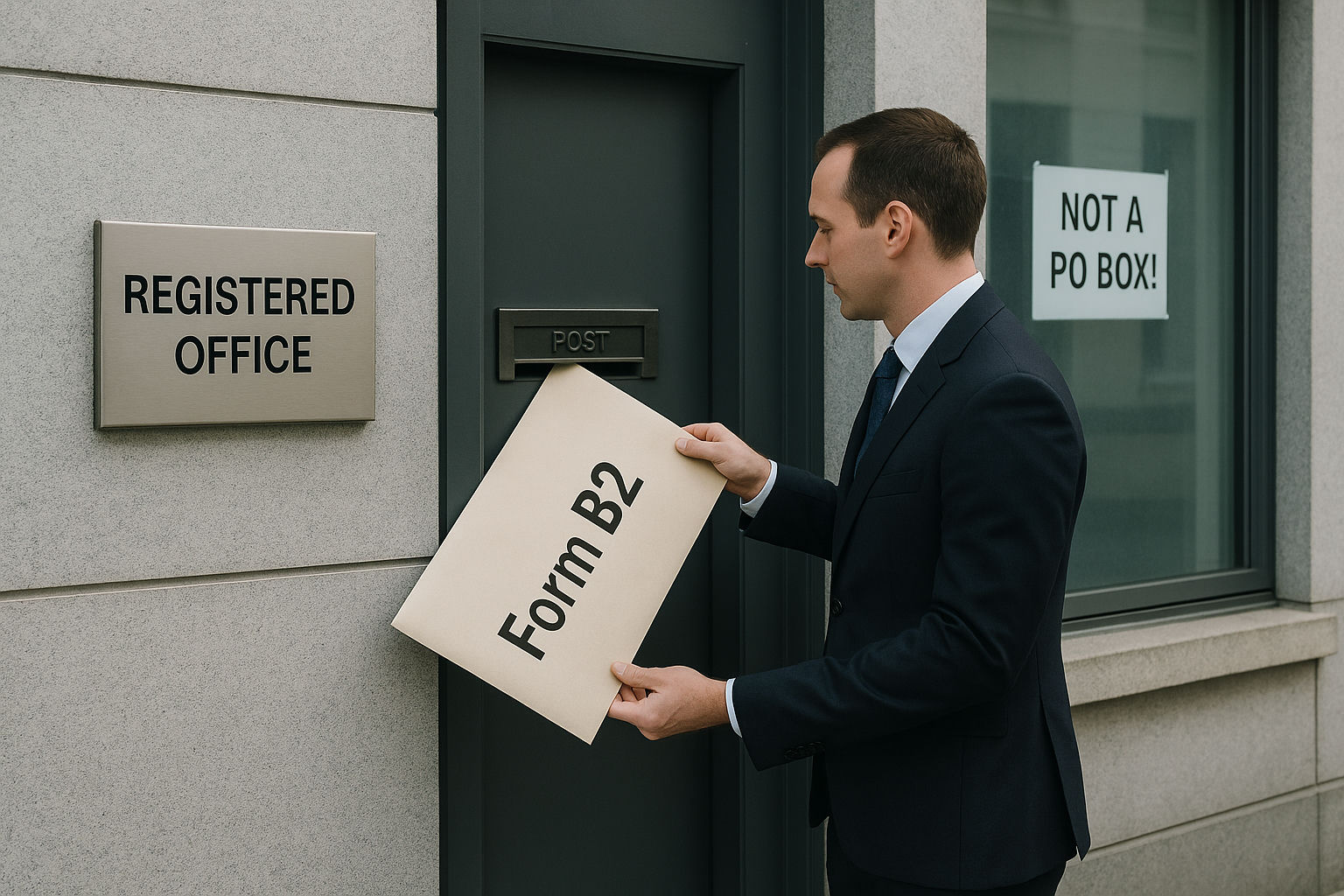
This article is for Irish company directors and business owners who need to change their registered office address or want to understand the legal requirements.
If you're wondering how to properly notify the CRO, what Form B2 involves, or what happens if you miss the 14-day deadline, this guide covers the complete legal process, filing requirements, and potential penalties.
Key Takeaways
• You must notify the CRO within 14 days of changing your registered office using Form B2 or face fines up to €5,000.
• Board approval through formal resolution is required before filing any registered office address change with the CRO.
• Your registered office must be a physical address in Ireland capable of receiving official post during business hours.
• Update all business documents including letterheads, invoices, and your website once the CRO registers your new address.
• Notify Revenue Commissioners separately about address changes to ensure tax correspondence reaches the correct location.

What Is a Registered Office Address?
Your registered office is the official legal address where your company receives all government correspondence and legal documents.
Section 50 of the Companies Act 2014 requires every Irish company to maintain a registered office address within the Republic of Ireland at all times.
This address serves as the primary contact point for the Companies Registration Office, Revenue Commissioners, courts, and other regulatory authorities.
The registered office can differ from your trading address or where you actually conduct business operations.
When Should You Change Your Registered Office?
Companies change their registered office address for various practical and strategic reasons.
Common triggers include:
- Relocating your business premises to a new location
- Switching from a home address to a professional business address for credibility
- Appointing a registered office agent to handle compliance
- Moving to premises owned by the company rather than rented space
- Consolidating multiple company addresses under one location
Some startups initially use a director's home address but later prefer a commercial address for privacy and professional image.
The key requirement is that any change must be properly notified to the CRO within the statutory deadline.
What Are the Legal Requirements?
Section 50(3) of the Companies Act 2014 imposes strict requirements on companies changing their registered office.
The registered office must be a physical address in the Republic of Ireland, not a PO Box number.
The address must be capable of receiving official post and documents during business hours.
Companies must notify the CRO of any change within 14 days of the change occurring.
Failure to comply with these requirements constitutes a Category 3 offense under the Act, potentially resulting in fines up to €5,000 for the company and its officers.
Do You Need Board Approval?
Yes, the board of directors must formally approve the registered office change before filing with the CRO.
The process typically involves convening a board meeting to discuss and approve the address change, passing a board resolution authorizing the change and empowering an officer to file the necessary forms, and recording the resolution in the company's minute book.
Shareholder approval is not usually required for registered office changes unless your company's constitution specifically requires it.
Certain company types like Designated Activity Companies may have constitutional provisions requiring additional approval procedures, so always check your constitution first.
What Is Form B2?
Form B2 is the official notification form used to inform the CRO of a registered office address change.
This form is submitted electronically through CORE (Companies Online Registration Environment), the CRO's online filing system.
Since June 2017, all Form B2 submissions must be filed electronically - paper submissions are no longer accepted.
The form requires basic information including the company's registered number and name, the new registered office address with full postal details, the date the change takes effect, and details of the officer filing the form.
Form B2 must be signed digitally by a current officer of the company, typically a director or the company secretary.
How Do You File Form B2?
Filing Form B2 through CORE is straightforward once you have the necessary information and board approval.
The step-by-step process involves:
- Access CORE at core.ie using your company's CORE credentials
- Select Form B2 from the available post-incorporation forms
- Complete the form with accurate new address details
- Enter the effective date when the change occurred or takes effect
- Digitally sign the form as an authorized officer
- Submit electronically through the CORE system
There is no filing fee for Form B2 submissions, making the process cost-free for companies.
The CRO typically processes Form B2 submissions within 3-10 business days, after which the new address appears on the public register.
When Does the Change Become Effective?
The registered office change becomes legally effective only when the CRO registers your Form B2 submission.
Until the CRO processes and registers the form, your old address remains the official registered office for all legal purposes.
Documents sent to the old address during this transition period are still considered properly served on your company.
You can check the status of your Form B2 submission through the CORE system and verify when the new address appears on the public register.
Must You Notify Revenue?
Yes, companies should notify the Revenue Commissioners separately about registered office changes, particularly when moving between counties.
While the CRO and Revenue systems don't automatically sync, Revenue typically becomes aware of changes through annual return filings.
However, proactive notification prevents correspondence going to the wrong address and ensures uninterrupted tax compliance.
You can update your address with Revenue through your ROS (Revenue Online Service) account or by contacting your local Revenue office directly.
How Often Can You Change Your Address?
There is no legal limit on how frequently a company can change its registered office address.
However, frequent changes create administrative burdens and may raise questions about company stability.
Each change requires:
- Board approval through formal resolution
- CRO notification within 14 days via Form B2
- Stationery updates for letterheads and marketing materials
- Notification to banks and other service providers
- Managing stakeholder confusion when trying to contact the company
Most companies change registered office only when genuinely necessary for operational reasons.
Excessive address changes might also trigger additional scrutiny from Revenue or other authorities concerned about company stability.
What Happens If You Don't Notify the CRO?
Failing to file Form B2 within 14 days of changing your registered office constitutes a breach of the Companies Act 2014.
The consequences can be severe and affect both the company and its officers personally.
Potential penalties include fines up to €5,000 for the company, personal fines for directors and company secretary, continued service of documents at the old address being legally valid, missed notices leading to strike-off proceedings, difficulty passing due diligence in investment or acquisition processes, and bank account compliance issues.
Directors can be held personally liable for compliance failures under their duties of ensuring proper company administration.
Must You Update Business Documents?
Yes, Section 51 of the Companies Act 2014 requires companies to display their registered office address on all business correspondence.
Documents requiring the registered office address include company letterheads, invoices and receipts, purchase orders, business cards, email signatures, and the company website.
You should update these materials promptly after the CRO registers your address change.
Continuing to show an outdated registered office address after it has changed can constitute an offense and creates confusion for people trying to contact your company.
Can Directors Use the Registered Office?
Directors can use the company's registered office address instead of their personal residential address in certain circumstances.
Section 150 of the Companies Act 2014 allows directors to apply for an exemption from publicly displaying their residential address if they can demonstrate serious risk to personal safety.
Benefits of using the registered office address include:
- Privacy protection avoiding home addresses on the public register
- Security benefits for directors facing personal safety concerns
- Professional appearance separating business from personal addresses
- Service address option available on certain forms even without formal exemption
The exemption application requires supporting evidence, typically a statement from An Garda Síochána confirming the security risk.
Even without this formal exemption, directors can list the registered office as their service address on certain forms.
What Records Must You Keep?
Companies must maintain proper records of all registered office changes as part of their statutory obligations.
Essential records include:
- Board resolution approving the address change
- Dated and signed board minutes recording the decision
- Copy of the filed Form B2 submission
- CRO confirmation that the form has been registered
- Related correspondence concerning the address change
These records should be retained permanently as part of the company's statutory books.
They may be required during audits, due diligence processes, or compliance reviews by authorities. Good corporate governance requires organized record-keeping of all significant company decisions and filings.

Laura Ryan is a practising Barrister at the Bar of Ireland. She graduated from the Honourable Society of King’s Inns in 2024, having previously qualified and practised as a Chartered Accountant in a big four accounting firm.