Irish founders, small business owners, and employers hiring senior staff who need to protect confidential information, client relationships, and workforce from departing employees.
Readers will gain practical insights on drafting enforceable covenants, passing the reasonableness test, avoiding pitfalls, and handling exits to safeguard their business under Irish employment law.
Key Takeaways
- Irish courts enforce restrictive covenants only if reasonable, protecting legitimate interests like confidentiality or clients, tailored to role.
- Non-compete clauses harder to enforce than confidentiality; limit to 6 months for seniors, match geography to business operations.
- Use tiered drafting by seniority, narrow definitions, severability; refresh on promotions.
- Garden leave often more reliable than post-termination restrictions.
- Enforce via quick injunctions with evidence; strong exit processes and credible threats key for deterrence.

Restrictive Covenants Ireland: Employment Guide
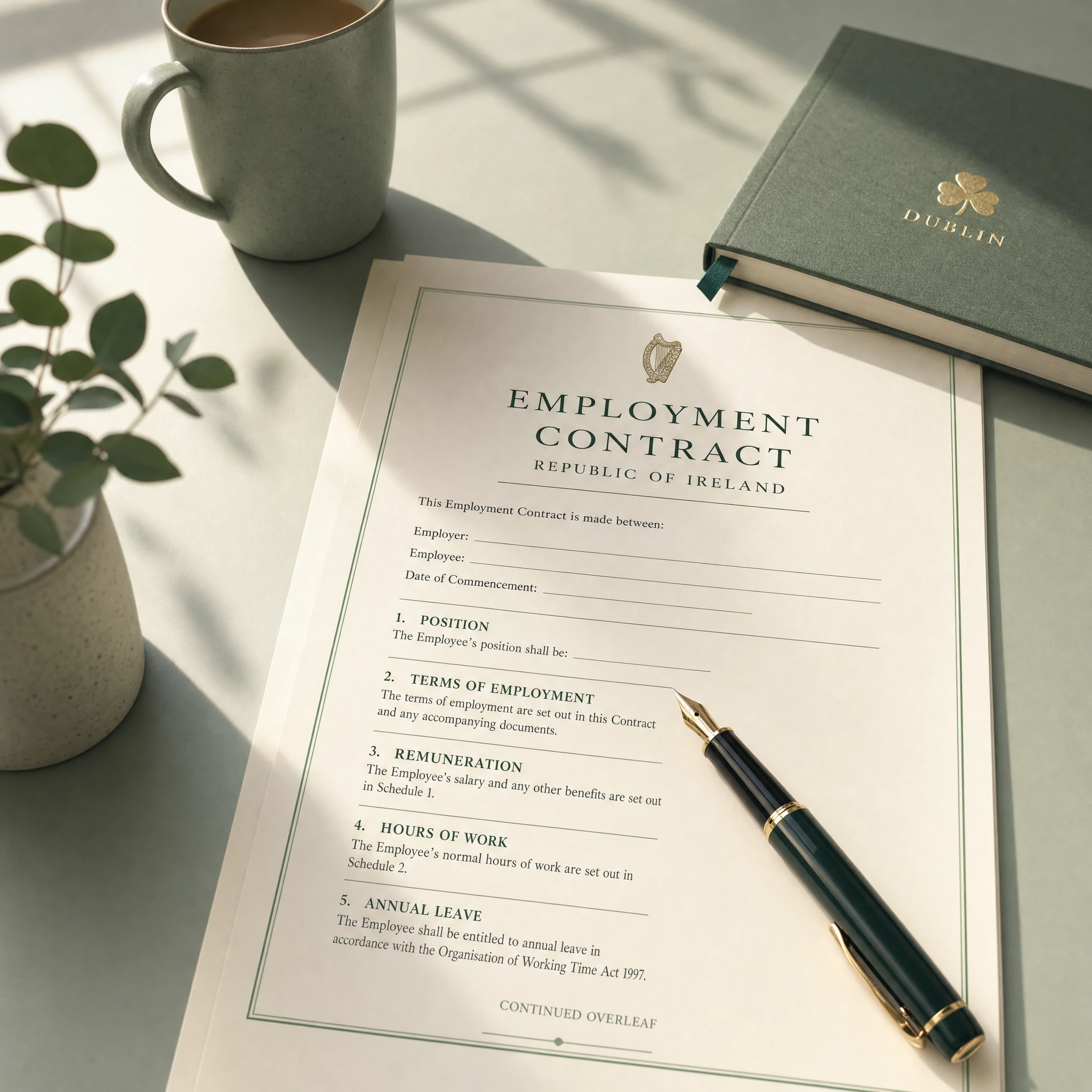
Most Irish employment contracts include a block of restrictive covenants near the back: non-compete, non-solicit, confidentiality. Most of them are drafted too widely to survive a court. If you are a founder relying on these clauses to protect your business, the question is not whether they look tough in the employment contract. It is whether they hold up when a senior hire walks out the door. This guide covers how Irish courts approach restrictive covenants employment Ireland employers use in practice, what the reasonableness test really looks like, and the drafting and exit decisions that decide whether you can actually enforce.
What are restrictive covenants in Irish employment contracts?
A restrictive covenant is a contractual provision that limits what an employee can do after they leave your business, for a defined period and within a defined scope. Under Irish law, these clauses sit in tension with the constitutional right to earn a livelihood, which is why the courts start from a position of scepticism.
There are four types you will see in a well-drafted Irish contract:
- Non-compete clauses stop an employee from joining or setting up a competing business for a set period and within a defined geography.
- Non-solicitation of customers clauses stop an employee approaching your clients or customers for a set period.
- Non-solicitation and non-poaching of staff clauses stop them recruiting your team.
- Confidentiality and IP protection clauses cover trade secrets, know-how, and company information.
Confidentiality tends to be the easiest to enforce. Non-compete is the hardest. Everything in between depends on how narrowly you have drafted it.
How does the Irish reasonableness test work?
Irish courts will only enforce a restrictive covenant if it protects a legitimate business interest and is no wider than is reasonably necessary to do so. That is the whole test, but it breaks down into four questions a judge will work through.
First, is there a legitimate interest to protect? Intellectual property, trade secrets, stable client relationships, and workforce stability generally qualify. Preventing ordinary competition does not.
Second, is the scope tailored to the role? A head of sales with a customer book is not the same as a graduate engineer. Blanket covenants that apply to everyone from junior hire to CEO tend to get struck down. In practice, tailoring is consistently the factor that decides enforceability.
Third, are duration and geography proportionate? As a working benchmark, often Irish and Irish-influenced practice treats non-compete clauses longer than 6 months against senior employees as hard to enforce, and non-solicit clauses longer than 12 months as difficult. Geography should match where the business actually operates.
Fourth, was the covenant agreed with proper consideration and at the right time? Clauses slipped in after someone has started, without fresh consideration, are more vulnerable than clauses signed at offer stage.
The key difference is: Irish courts do not rewrite a bad clause to make it reasonable. They either enforce it as drafted, use the limited "blue pencil" rule to sever severable wording, or strike it out entirely. In our experience, drafting too wide is not a safe default.
Drafting tips for small Irish employers
The practical implication is that one contract template for your whole team is a bad idea. A defensible pattern uses tiered covenants by role. For senior hires with real access to clients or IP, use fuller restrictions. For junior staff, confidentiality plus a short non-solicit is usually all that survives.
A few drafting habits that help are as follows:
- Define "competitor" narrowly: by product, service, or named market, not "any business competing with the employer".
- Define the geography: "the Republic of Ireland" or "the counties in which the employer actively trades" works. "Worldwide" rarely does.
- Define the protected information: not "all information", but categories the employee genuinely had access to.
- Use severability language so a single overbroad word does not take the whole clause down.
- Refresh covenants on promotion. An employee promoted from analyst to head of sales should sign an updated set of terms.
Garden leave is the other lever. If your contract gives you a proper garden leave period, you can keep a departing employee out of the market during notice while they remain paid and bound by duties. It is usually more reliable than a post-termination non-compete.
Enforcing restrictive covenants in practice
Even a well-drafted covenant is only as good as your willingness and ability to enforce it. In Ireland, enforcement usually means seeking an interim or interlocutory injunction in the High Court, quickly, once you become aware of the breach.
Speed matters. The longer you leave it, the harder it becomes to argue irreparable harm. Evidence matters too: you will need to show what confidential information the employee had, how it could be used, and what the specific risk is. In our experience, vague assertions about loss of goodwill will not carry the day.
In practice, this means: many Irish employers settle for strongly worded letters, undertakings, and negotiated departures rather than a full injunction. That is fine, but only if the underlying clause is enforceable enough to make the threat credible.
Cost is the other factor. A High Court injunction is not cheap, and most small employers will only pursue it for senior departures with a live competitive risk. For everyone else, the covenant is a deterrent, not a weapon.
Common drafting mistakes to avoid
The mistakes that kill enforceability in Ireland are familiar and repeated across every industry we see.
Copy-pasting US or UK clauses without adjustment is the most common. A twelve-month worldwide non-compete might be standard in a US VP contract. In Ireland, it is almost unenforceable.
Identical covenants across all staff is the second. If a graduate hire has the same non-compete as your CTO, a court will assume the clause is not tied to any specific legitimate interest.
Failure to update contracts on promotion is the third. The covenant that made sense for the junior role is the one that binds the senior hire.
Finally, sloppy exit processes weaken enforcement. If you pay out without reminding the departing employee of their obligations, do not take possession of devices, and do not document what confidential information they had, a court will notice.
Handling the exit process
The enforceability of a restrictive covenant is shaped by what you do in the last two weeks of employment, not just what the contract says.
Run a consistent leaver process. Remind the employee in writing of their ongoing obligations, including confidentiality and any post-termination restrictions. Take back devices and accounts. Document what was handed over. If you are using garden leave, issue the instruction in writing.
References are a separate trap. A glowing reference to a direct competitor can undermine a later non-compete argument. We recommend that you keep references factual and consistent with your stated position.
If the employee is going to a named competitor, consider a short undertaking letter rather than straight into court. An agreed undertaking that the employee will not contact specific clients for six months, for example, is quicker, cheaper, and often more realistic than an injunction.
Where there is a real concern about a co-founder or executive competing, the covenant is only one part of the response. Directors' duties, fiduciary duties, and confidentiality obligations run in parallel and can be easier to rely on.
What to do next
Irish courts will enforce restrictive covenants that are tailored, proportionate, and tied to a legitimate business interest. They will not enforce blanket clauses copied from a US template and applied to everyone on the team. If your current contracts have not been reviewed against a specific role in the last year, assume there are clauses that will not survive a real test.
Start with your senior hires, tighten the scope, and make sure your exit process backs up what the contract says. If you want a second pair of eyes before a key hire or an awkward departure, Open Forest can walk through your contracts with you and flag the clauses most likely to fail under pressure.

Laura Ryan is a practising Barrister at the Bar of Ireland. She graduated from the Honourable Society of King’s Inns in 2024, having previously qualified and practised as a Chartered Accountant in a big four accounting firm.