Irish employers, HR professionals, payroll managers, and business owners looking for cost-effective ways to motivate and reward staff without high tax costs.
This article provides essential guidance on rules, eligible benefits, compliance steps, and common pitfalls, enabling readers to implement the scheme confidently and achieve real tax savings.
Key Takeaways
- Employers can provide up to €1,500 in tax-free non-cash benefits per employee per year from 2025.
- Up to five separate benefits allowed, but combined value cannot exceed €1,500.
- Benefits must be non-cash, not convertible to cash, and not part of salary sacrifice arrangements.
- If conditions are not met, the entire benefit becomes taxable, not just the excess.
- Report benefits to Revenue in real-time under ERR; applies to payroll employees only, not contractors.

€1,500 Small Benefit Exemption in Ireland
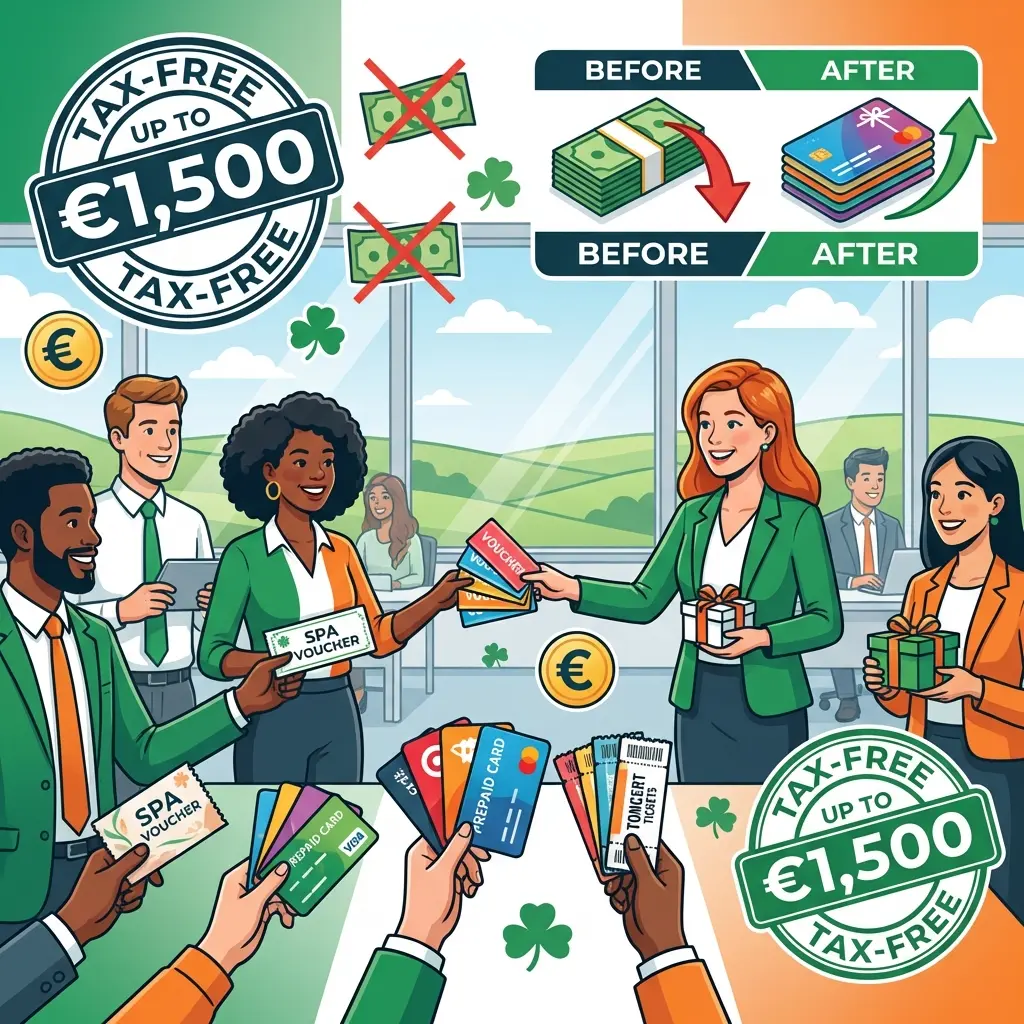
The Small Benefit Exemption Scheme offers Irish employers a tax-efficient way to reward employees without incurring the significant costs associated with cash bonuses. From 1 January 2025, employers can provide up to €1,500 in tax-free benefits annually to each employee, exempt from income tax, PRSI, and USC. Understanding the conditions and compliance requirements is essential for both employers and employees to maximize this valuable benefit.
Understanding the Small Benefit Exemption
The Small Benefit Exemption Scheme allows employers to provide non-cash benefits to employees without triggering tax liabilities. This means qualifying benefits are completely exempt from PAYE income tax, Universal Social Charge (USC), and both employer and employee PRSI contributions.
From 1 January 2025, the scheme permits employers to give up to five separate benefits per employee per calendar year, with a combined maximum value of €1,500. Alternatively, employers can provide a single benefit worth up to €1,500.
The tax savings are substantial. For example, if an employer provides a €1,500 cash bonus through regular payroll, the actual cost including employer PRSI could exceed €3,400, and the employee would receive significantly less after deductions. Under the Small Benefit Exemption, the employer pays exactly €1,500, and the employee receives the full €1,500 value.
Conditions for Claiming the Exemption
To qualify for the Small Benefit Exemption, specific conditions must be met. Failure to meet any of these conditions renders the entire benefit taxable, not just the excess amount.
1. Non-Cash Requirement
The benefit must be provided in a non-cash form. Cash payments, even if called a 'gift,' are fully taxable. The benefit must also not be convertible to cash, either in whole or in part. This means prepaid cards that allow ATM withdrawals do not qualify, as they can be redeemed for cash.
2. Maximum Value Limit
The combined value of all benefits provided to an employee in a calendar year cannot exceed €1,500. If a single benefit exceeds this threshold—even by €1—the full value becomes subject to PAYE, USC, and PRSI. This is a critical distinction: there is no partial exemption. A benefit worth €1,501 is entirely taxable.
3. Maximum Number of Benefits
Up to five benefits can be provided per employee per year. If more than five benefits are given, only the first five qualify for the exemption. Any subsequent benefits are fully taxable. Employers cannot choose which benefits to exempt—it is strictly the first five provided in chronological order.
4. No Salary Sacrifice Arrangements
The benefit cannot form part of any salary sacrifice arrangement. This means an employee cannot agree to reduce their salary or forego any remuneration in exchange for receiving a benefit under this scheme. The benefit must be genuinely additional to the employee's regular compensation. If an employee accepts a voucher in lieu of unpaid salary or as part of a contractual salary reduction, the exemption does not apply.
5. No Carryover of Unused Allowance
The €1,500 allowance is annual and cannot be carried forward to subsequent years. If an employer provides €1,000 in benefits in 2025, the unused €500 does not roll over to 2026.
What Qualifies as an Eligible Small Benefit
Eligible benefits must be tangible, non-cash items or vouchers restricted to purchasing goods or services. Common examples include:
The employer must purchase the benefit directly. An employee cannot buy a voucher themselves and seek reimbursement from their employer, as this would not qualify for the exemption.
What Does Not Qualify
Minor costs such as postage or administrative fees when purchasing vouchers are not included in the €1,500 threshold calculation, provided they are nominal.
Who Can Receive the Benefit
The Small Benefit Exemption applies to all employees on the company payroll. The scheme is entirely voluntary. Employers are not required to provide benefits to all employees equally. Different employees can receive different amounts, or some employees may receive benefits while others do not. There is no obligation to provide the full €1,500 to any employee.
Importantly, the exemption does not apply to contractors, freelancers, or self-employed individuals, as they are not classified as employees for tax purposes.
Compliance and Reporting Requirements
The Small Benefit Exemption falls under Revenue's Enhanced Reporting Requirements (ERR). This means employers must report qualifying benefits to Revenue in real-time, on or before the benefit is provided to the employee.
What Must Be Reported
Employers must submit the following information through their payroll software to Revenue:
Most modern payroll software includes functionality to log and submit these details automatically when processing payroll submissions to Revenue's ROS (Revenue Online Service) system.
Record Keeping
Employers must maintain accurate records of all benefits provided under the scheme. In the event of a Revenue audit, the company's accounts must demonstrate that the total value of benefits invoiced under the exemption does not exceed the number of employees multiplied by €1,500.
Proper documentation should include purchase invoices, voucher receipts, and records of which employees received which benefits and when. These records should be retained for at least six years, consistent with general tax record-keeping requirements.
Avoiding Tax Implications
Understanding the rules is crucial because non-compliance results in the entire benefit becoming taxable. Common pitfalls to avoid include:
Practical Guidance for Employers
To maximize the benefits of this scheme while ensuring compliance, employers should:
Key Points to Remember
Conclusion
The €1,500 Small Benefit Exemption Scheme offers a powerful, tax-efficient way for Irish employers to reward and appreciate their employees. By understanding the conditions, ensuring compliance with reporting requirements, and avoiding common pitfalls, both employers and employees can benefit from significant tax savings. Whether used for year-end bonuses, recognition of achievement, or simply as a gesture of appreciation, this scheme provides genuine value while maintaining simplicity and flexibility for businesses of all sizes.

Paul Burke is a qualified ACA and CTA tax accountant in Ireland.He trained at Forvis Mazars in Galway, gaining experience in various tax heads including Income Tax, Corporation Tax, VAT, Payroll and Tax Advisory.He is now a Tax Consultant in a local tax firm.