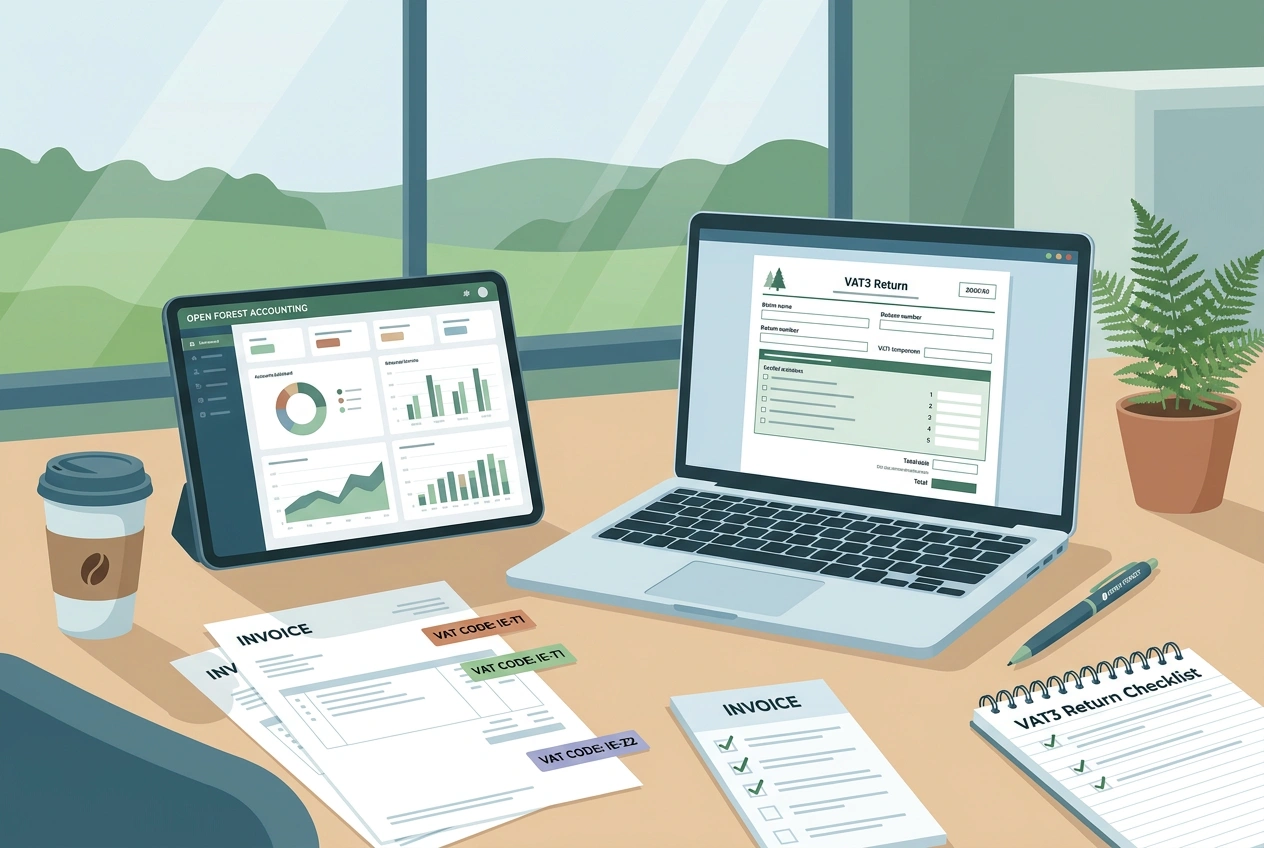
Finance leads, owners and bookkeepers in Irish limited companies who want repeatable, audit-ready monthly accounts without last-minute scrambling at year-end.
Readers will gain a practical four-day close process with clear sequencing, control-account checks, and reporting standards that satisfy Companies Act 2014 record-keeping duties.
Month-End Close Checklist for Irish Small Companies
A month-end close turns your bookkeeping from a stack of transactions into very benefical management information. Done well, you have decision-grade numbers on the fifth working day of every month, year-end takes a fraction of the usual time, and investors and lenders take you seriously. Done badly, you spend the second half of every quarter chasing what should already be known.
This guide is a repeatable checklist for closing the books in a small Irish company, in the order that catches the most issues with the least effort.
Why month-end close matters
A month-end close gives you four things:
Decision-grade numbers. Cash position, profitability, runway, and margin are accurate to the cent for the closed periodEarly error detection. Mistakes caught at month-end cost minutes; the same mistakes caught at year-end cost daysCredibility. Banks, investors, and acquirers all read monthly management accounts before they read annual onesA small year-end. When the monthly close is solid, year-end becomes a roll-forward and an audit prep exercise, not a rebuild
The legal duty to keep adequate accounting records under Sections 281 to 286 of the Companies Act 2014 is satisfied much more easily by twelve monthly closes than by one frantic January.
The order of operations
Run the close in this sequence:
Bank, card, and processor reconciliation
Sales and debtors review
Purchases and creditors review
Accruals and prepayments
Payroll and VAT cross-checks
Director's loan and intercompany accounts
Reporting and lock-down
Skipping ahead causes rework. The bank rec catches missing items the rest of the checklist cannot.
Step 1: Reconcile every cash account
Every bank account, credit card, payment processor, and foreign currency wallet gets reconciled to its external statement for the period. The closing book balance must equal the closing statement balance with no unreconciled items.
The mechanics are the same for each: pull the feed, match obvious items, code the rest, investigate the differences, run the reconciliation report . A clean rec is the foundation everything else rests on; it is also the foundation of your double-entry bookkeeping for the period.
For multi-currency businesses, revalue all foreign-currency balances at month-end rates and post the FX gain or loss.
Step 2: Sales and debtors review
Once cash is solid, look at what is owed to the company:
Confirm every sale in the period has an invoice raised and posted
Review the aged debtors list and chase anything over thirty days
Provide for bad debts on amounts you no longer expect to recover
Cut off correctly: a sale earned in the period but invoiced later needs an accrual; a sale invoiced this period but earned in the next needs deferring
For subscription or SaaS businesses, post the deferred revenue movement for the period
The cut-off discipline is what separates real management accounts from a cash summary.
Step 3: Purchases and creditors review
Mirror the same work on the supplier side:
Confirm every supplier invoice for the period is recorded, including the ones that arrive a week late
Accrue for goods or services received but not yet invoiced (utilities, rent, recurring software)
Review the aged creditor report and plan payments
Pull director-paid items into the director's loan account
Cut off correctly: a cost incurred in the period but not yet invoiced is an accrual; an invoice paid for next period's service is a prepayment
Missed creditor invoices are the single最 common reason monthly numbers swing when the year-end accounts arrive.
Step 4: Accruals and prepayments
These are the entries that turn cash bookkeeping into accrual accounting. The recurring ones in most small Irish companies:
Rent paid quarterly: prepayment if paid in advance, accrual if billed in arrears
Insurance paid annually: prepayment, released over twelve months
Software billed annually: prepayment, released over twelve months
Utilities and telecoms invoiced after the period: accrual for the estimated consumption
Year-end bonuses or commissions earned but not yet paid: accrual
Set up standing journals for the predictable ones and copy them forward each month. Investigate why the actual invoice differs from the accrual when it arrives. The glossary entry on accruals covers the conceptual underpinning.
Step 5: Payroll, VAT, and tax cross-checks
Three control accounts must hit zero (or the expected balance) every month:
Payroll control. Gross pay accrued to staff equals net pay paid plus PAYE/USC, PRSI, and pension liabilities. Each liability clears when paid to Revenue or THE pension provider.VAT control. Output VAT minus input VAT for the period equals the VAT3 liability (or refund). The control account zeroes when the return is paid or the refund received. Read our VAT essentials guide for the underlying mechanics.PAYE/USC, PRSI, and pension liabilities. Each clears against bank when the corresponding payment is made.
If any control account refuses to clear, the issue is upstream in the bookkeeping and worth ten minutes of investigation now rather than ten hours at year-end.
Step 6: Director's loan and intercompany accounts
For owner-managed Irish LTDs:
Confirm the director's loan account balance against the director's own records
Disclose any overdrawn position to the directors before it becomes a Section 239 issue
For groups, agree intercompany balances both ways before locking the period
For limited companies, confirm any dividends declared in the period are posted with matching shareholder resolutions
We see small companies have significant end of year issues, where the directors account is not monitored regularly. Directors can build up signifcant balances without realising which can have but significant tax and company law implications. Catching an unexplained drift here protects the year-end statutory disclosures.
Step 7: Reporting and lock-down
Produce the close pack:
Profit and loss for the month, with prior-month and budget comparatives
Balance sheet at month-endCash flow statement and runway calculationVariance commentary on anything material
A one-page "close memo" highlighting issues, decisions taken, and items to revisit
Then lock the period in the accounting software so no historical changes can creep in. Save the close pack to the company's document archive in line with our document retention guide .
A practical monthly cadence
For a small Irish company, the close should comfortably fit in four working days after month-end:
Day 1. Bank, card, and processor reconciliationsDay 2. Sales, debtors, purchases, creditorsDay 3. Accruals, prepayments, payroll, VAT, taxDay 4. Director's loan, reporting, lock-down
By month three the routine compresses. Most well-organised SMEs run a same-week close by the end of the first quarter.
How it scales to year-end
A clean monthly close is the cheapest form of audit prep. At year-end you only need to:
Run a thirteenth close with extended cut-off testing
Confirm fixed asset additions and depreciation
Post tax provisions
File the annual return and statutory accounts
Any company that skips monthly closes will rebuild every one of the previous twelve months at year-end. That is when bookkeeping costs spiral and can be at a time when they are already under the most time pressure.
What to do next
Block the first four working days of next month for the close routine. Use the order above. After three cycles, the routine compounds and the time required halves. If the backlog is too big to start, run a clean-up project on the last completed quarter before adopting the monthly cadence.
Open Forest can run the monthly close for your Irish company, build the close pack template, and produce the management accounts your board needs.