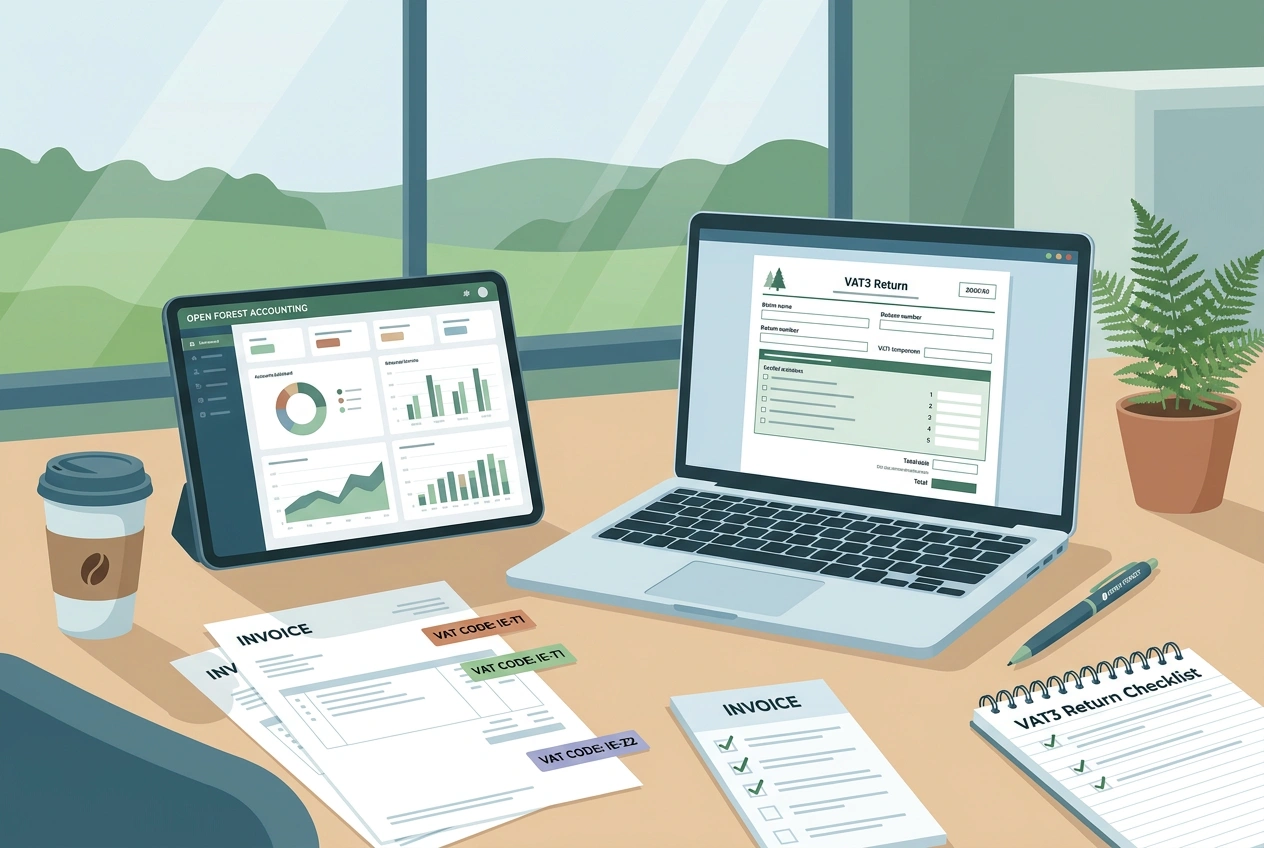
VAT bookkeeping Ireland changes the moment your company becomes VAT-registered because your books now need to track tax collected, tax reclaimed and the net amount due to Revenue.
Before VAT registration, a sale is usually recorded as income and a purchase as a cost. After registration, part of many invoices belongs to Revenue or may be recoverable from Revenue. That means your day-to-day bookkeeping needs better invoice capture, correct VAT codes and regular checks against the VAT3 return.
What changes when your company becomes VAT-registered?
A VAT-registered company must record VAT on relevant sales and purchases so it can file accurate VAT returns.
The main change is that VAT becomes a balance sheet item as well as a cash-flow issue. When you charge VAT on sales, you are collecting tax for Revenue. When you pay VAT on allowable purchases, you may be able to reclaim it. Your books need to separate the net sale or purchase from the VAT amount.
From day one, your bookkeeping should capture:
Sales invoices with the correct VAT rate
Purchase invoices with reclaimable and non-reclaimable VAT separated
Reverse charge entries where they apply
VAT-only adjustments and corrections
The VAT control account balance
The figures needed for VAT3 and the Annual Return of Trading Details
A useful foundation is understanding Value Added Tax before building the bookkeeping process around it.
How does the VAT control account work?
The VAT control account records VAT owed to or recoverable from Revenue at a point in time.
Output VAT on sales normally increases the amount owed to Revenue. Input VAT on allowable purchases normally reduces it. At the end of the VAT period, the net balance should agree to the VAT3 return.
For example, if your company charges €4,600 VAT on sales and reclaims €1,200 VAT on purchases, the VAT control account should show €3,400 payable before any payments or adjustments. When the VAT payment is made through ROS , the balance should clear.
The control account is where many VAT problems show up. Old balances, manual journals, incorrect VAT codes and duplicate invoices can all leave the account out of line with the return.
Author's tip: Reconcile the VAT control account before filing the VAT3, not after. If the account does not agree to the return, the return may be wrong or the books may be incomplete.
This is why VAT bookkeeping should be reviewed regularly, not only when the filing deadline arrives.
How should sales be coded for VAT?
Sales invoices should be coded by VAT treatment, not just by customer or income type.
The same company may have standard-rated sales, zero-rated sales, exempt income , reverse charge supplies and out-of-scope income. These are not interchangeable. Each treatment affects the VAT3 and the Annual Return of Trading Details differently.
Your sales process should capture:
The VAT rate charged
Whether the customer is in Ireland, the EU or outside the EU
Whether the customer is a business or consumer
Whether reverse charge rules apply
Whether the supply is exempt, zero-rated or outside the scope of VAT
The distinction between exempt and zero-rated matters. Zero-rated sales may still allow input VAT recovery, while exempt sales can restrict recovery. If the bookkeeping treats them the same, the VAT return can be misleading.
A clean sales ledger makes this easier because each customer invoice is recorded with the correct VAT treatment from the start.
How should purchases be coded for VAT?
Purchase invoices should be coded based on whether VAT can be reclaimed and how the supplier has charged it.
Not every VAT amount on a supplier invoice is automatically recoverable. Entertainment, personal-use elements and some motor expenses can be restricted. Imports and cross-border services can also require reverse charge treatment, even where the supplier has not charged Irish VAT.
A VAT-ready purchase process should check:
Is there a valid invoice?
Is the supplier Irish, EU or non-EU?
Is the purchase for business use?
Is the VAT recoverable, blocked or partly restricted?
Does reverse charge apply?
Is the invoice posted to the right period?
The purchase ledger should support those checks. If purchase invoices are entered with generic VAT codes, the VAT3 may still produce a number, but it may not be a reliable one.
Revenue have recently confirmed they are rolling out mandtory e-invoicing and real-time VAT reporting, which will start with large corporations with domestic B2B transactions, with all VAT-registered businesses in intra0EU trade required to be fully compliant by July 2030. It is therefore important that all VAT registered customers are ready for this incoming requirement.
Cash receipts basis or invoice basis: what changes in the books?
The VAT basis determines when VAT becomes payable or reclaimable, so the bookkeeping system must match the basis your company uses.
Under the invoice basis, VAT is generally accounted for by reference to invoice dates. Under the cash receipts basis, VAT on sales is generally linked to when payment is received, where the company is eligible and Revenue rules allow it.
This affects cash flow . A company on the invoice basis may owe VAT before a customer pays. A company on the cash receipts basis may have timing relief, but only if the bookkeeping system tracks receipts correctly.
In practice, this means: If you use the cash receipts basis, your bookkeeping cannot stop at invoice entry. It must also match customer receipts accurately, because payment timing drives the VAT treatment.
If you switch basis or set it up incorrectly in accounting software, review the first VAT period carefully. A small setup error can roll forward into every return, which we do see creates significant issues down the line, with potential penalties and interest being applied by Revenue.
What feeds a clean VAT3 return?
A clean VAT3 return comes from properly coded sales, purchases, reverse charge entries and adjustments.
Revenue requires VAT returns to be true and correct. For ROS filers, the VAT filing deadline is the 23rd day of the month following the end of the taxable period. That gives a little time after period end, but not enough to rebuild two months of poor bookkeeping.
Before filing, check:
Sales VAT by code agrees to sales reports
Purchase VAT by code agrees to purchase reports
Reverse charge entries are balanced
Credit notes are included in the right period
The VAT control account agrees to the return
Any manual adjustments are documented
The basic source document remains the invoice . If invoices are missing, late or coded inconsistently, the VAT3 return will inherit those weaknesses.
Want VAT-ready books before the next return?
Open Forest can review your VAT codes, control account and VAT3 workflow so your bookkeeping supports the return instead of creating filing pressure.
How does the RTD depend on bookkeeping detail?
The Annual Return of Trading Details depends on detailed VAT-coded totals from the full year.
The RTD summarises sales and purchases by VAT rate. Revenue guidance states that the figures are entered exclusive of VAT and that the RTD does not show VAT liability or refund information. That means it is not enough for the VAT control account to be broadly right. The underlying VAT code detail must also be right.
A year-end VAT cleanup should review:
Sales split by VAT rate
Purchases split by VAT rate
Exempt and zero-rated turnover
Reverse charge transactions
Imported services or goods
Credit notes and corrections
The Annual Return of Trading Details is easier to complete when VAT coding has been consistent all year. If it has not, the RTD becomes a reconstruction exercise.
What to do next
VAT registration is not just a tax milestone. It changes the bookkeeping standard your company needs.
Set up the VAT codes properly, reconcile the VAT control account each period, review unusual transactions before filing and keep the RTD in mind throughout the year. Open Forest can help you build a VAT-ready bookkeeping process that supports clean returns and stronger tax compliance .