Founders, small business owners, and employers hiring new staff in Ireland should read this article to navigate probation periods correctly and avoid litigation risks.
They will learn essential legal requirements, day-one protections, how to structure clauses, conduct fair procedures, extend probation legally, and sidestep common pitfalls highlighted for founders.
Key Takeaways
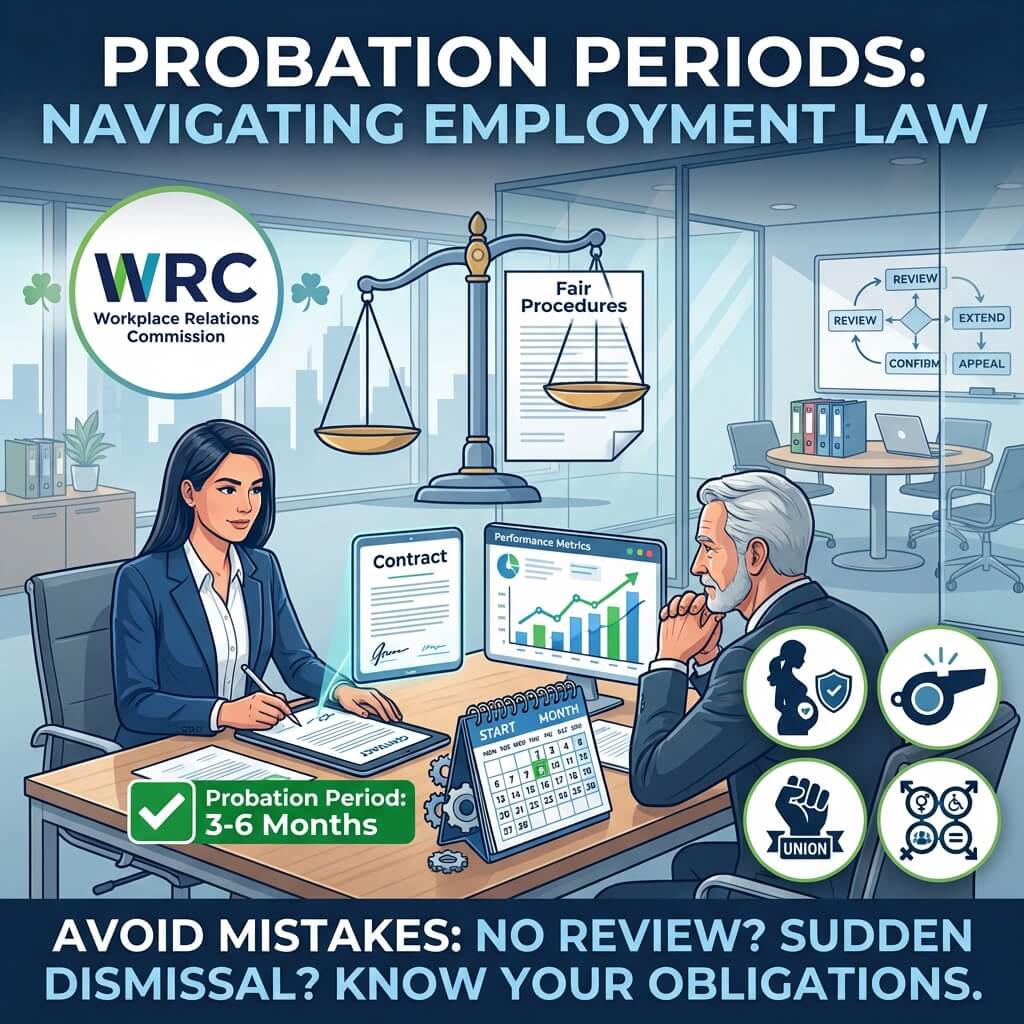
- Probation reduces procedural burden for dismissal but does not remove employment law protections, which apply from day one.
- Employees protected immediately from dismissal for pregnancy, whistleblowing, union activity, statutory rights, or discrimination.
- Valid probation requires clear written contract clause including duration, performance condition, notice, and extension rules; max 6-12 months.
- Fair procedures still apply: raise concerns early, formal meeting, response chance, written decision, appeal.
- Common mistakes include no formal review, late concerns, no meeting, using probation to cover protected dismissals.

What Does a Probation Period Actually Do?
A probation period gives you a defined window, typically three to six months, to assess whether a new hire is right for the role. During that window, dismissal is easier, but you should be aware that it is not consequence-free. What probation genuinely does is reduce the procedural burden compared to dismissing a fully settled employee. You don't need to go through a full multi-stage performance improvement plan before making a decision. A shorter, less formal process is generally acceptable, provided it exists at all. What probation does not do is disapply employment law. The employee is employed from day one, and the protections that attach to employment attach immediately.
What Are Employees Protected From on Day One?
The Unfair Dismissals Acts 1977–2015 generally require 12 months' continuous service before an employee can bring a claim. But there are significant exceptions. From the first day of employment, employees cannot be dismissed for:
- Pregnancy or maternity-related reasons
- Making a protected disclosure (whistleblowing) under the Protected Disclosures Acts
- Trade union membership or activity
- Exercising a statutory right, such as requesting parental leave or flexible working
- Race, gender, age, disability, or other protected characteristics under equality legislation
A dismissal during probation for any of these reasons exposes you to a claim regardless of service length. Compensation in these cases can be substantially higher than standard unfair dismissal awards.
What Does a Valid Probation Clause Look Like?
For a probation period to be legally effective, it needs to be clearly stated in the written contract of employment. A valid probation clause should include:
- The duration of the probationary period
- A statement that employment is subject to satisfactory performance during probation
- The notice period that applies during probation (which can be shorter than post-probation notice)
- Whether and how probation can be extended
- A clear statement that the employee will be assessed and reviewed during the period
Verbal agreements about probation carry little weight. If it isn't in the contract, you cannot rely on it. The Employment (Miscellaneous Provisions) Act 2018 also limits probation periods to six months, with an option to extend to 12 months in exceptional circumstances. Contracts that specify longer probation periods than this are not enforceable beyond that limit.
Can You Extend Probation?
Yes, but only if the contract expressly permits it. A contract that simply states a three-month probation period, with no mention of extension, does not give you the right to extend it unilaterally. Where extension is permitted, the following applies:
- The employee must be notified in writing before the original probation period ends
- The reason for extension should be clearly explained, typically ongoing performance concerns
- The total probation period cannot exceed 12 months under the Employment (Miscellaneous Provisions) Act 2018
- A further review should be scheduled, with clear targets or expectations communicated
Extending probation without a contractual basis or extending it more than once to avoid making a decision, is the kind of thing that looks bad before the WRC if the employee is eventually dismissed.
What Fair Procedures Are Still Required During Probation?
The assumption is that probation means you can simply tell someone it isn't working out and end the contract. That assumption is incorrect. Even during probation, the basic principles of fair procedure still apply. The WRC's Code of Practice on Grievance and Disciplinary Procedures does not disappear because someone is on probation. In practice, during probation you should:
- Identify concerns early and raise them with the employee directly, not save them up for the end
- Hold a formal meeting to discuss the concerns, giving the employee reasonable notice
- Allow the employee to respond to what you've raised before any decision is made
- Issue the decision in writing, with reasons
- Offer a right of appeal, even if the probation period has ended
The process can be shorter and less formal than a full disciplinary procedure. But there must be a process. A brief mid-probation review and a documented end-of-probation meeting, even when things are going well, creates a paper trail that protects you either way. If performance issues arise later, you have a baseline. If you need to let someone go, you have evidence that concerns were raised and the employee had an opportunity to respond.
The Most Common Probation Mistakes Founders Make
Letting probation expire without a formal review.
If probation ends and you haven't formally assessed the employee, they transition automatically into permanent employment. Making a decision to let someone go the day after probation expires is procedurally much harder than doing so during probation.
Waiting until the last week to raise concerns.
If you have concerns at week three, raise them at week three. Leaving everything until the final days of a three-month probation doesn't give the employee a meaningful chance to improve, and adjudicators notice that.
Dismissing without a meeting.
A letter or a conversation saying "it's not working out" with no prior discussion and no documented reasons is the type of dismissal that generates WRC claims, even during probation. It takes very little time to do this properly.
Using probation as cover for a protected reason.
If an employee raises a grievance, discloses a pregnancy, or makes a complaint during probation and is let go shortly after, the timing creates a serious litigation risk. The burden on you to prove the dismissal was unrelated is significant.
What Notice Are You Required to Give?
During probation, the notice period in the contract applies, and this can be shorter than the statutory minimum in some cases, provided it is at least one week. The Minimum Notice and Terms of Employment Acts 1973–2005 set out the statutory minimums based on length of service. For employees with less than two years' service, this is one week. Many contracts specify a shorter notice period during probation, two weeks is common. This is valid, provided it is clearly stated in the contract and meets the statutory minimum. Paying in lieu of notice is generally permitted where the contract allows it or the employee agrees.

Laura Ryan is a practising Barrister at the Bar of Ireland. She graduated from the Honourable Society of King’s Inns in 2024, having previously qualified and practised as a Chartered Accountant in a big four accounting firm.