Irish founders, company directors and finance staff who issue sales invoices and need to ensure VAT and Corporation Tax compliance from day one.
Readers will learn the exact mandatory fields for VAT invoices, simplified invoice rules, credit note procedures, and upcoming e-invoicing deadlines so they can set up correct templates immediately.
An invoice is more than a request for payment in Ireland. It is the primary record Revenue and the CRO use to test whether your bookkeeping is real, your VAT is correct, and your company is trading at arm's length. Get the content right and you make every downstream filing easier. Get it wrong and you can find yourself in a Revenue audit defending why your customer's VAT recovery should still be allowed.
This guide covers what must appear on a compliant Irish sales invoice for VAT-registered and non-VAT-registered businesses, how to handle credit notes, and the e-invoicing rules that begin to bite from November 2028.
Why invoice compliance matters
A compliant invoice is the supporting evidence behind almost every VAT3 line, every Corporation Tax deduction, and every entry in your sales ledger. When that evidence is incomplete, three things follow:
Your customer's input VAT claim can be denied
Revenue can assess penalties for under-recording
Auditors will issue qualified opinions or management letters
The underlying rules sit in the VAT Consolidation Act 2010 and Revenue's Tax and Duty Manuals on invoicing. They feed into the tax compliance duties every director must already meet under the Companies Act 2014 .
Mandatory content on a VAT invoice
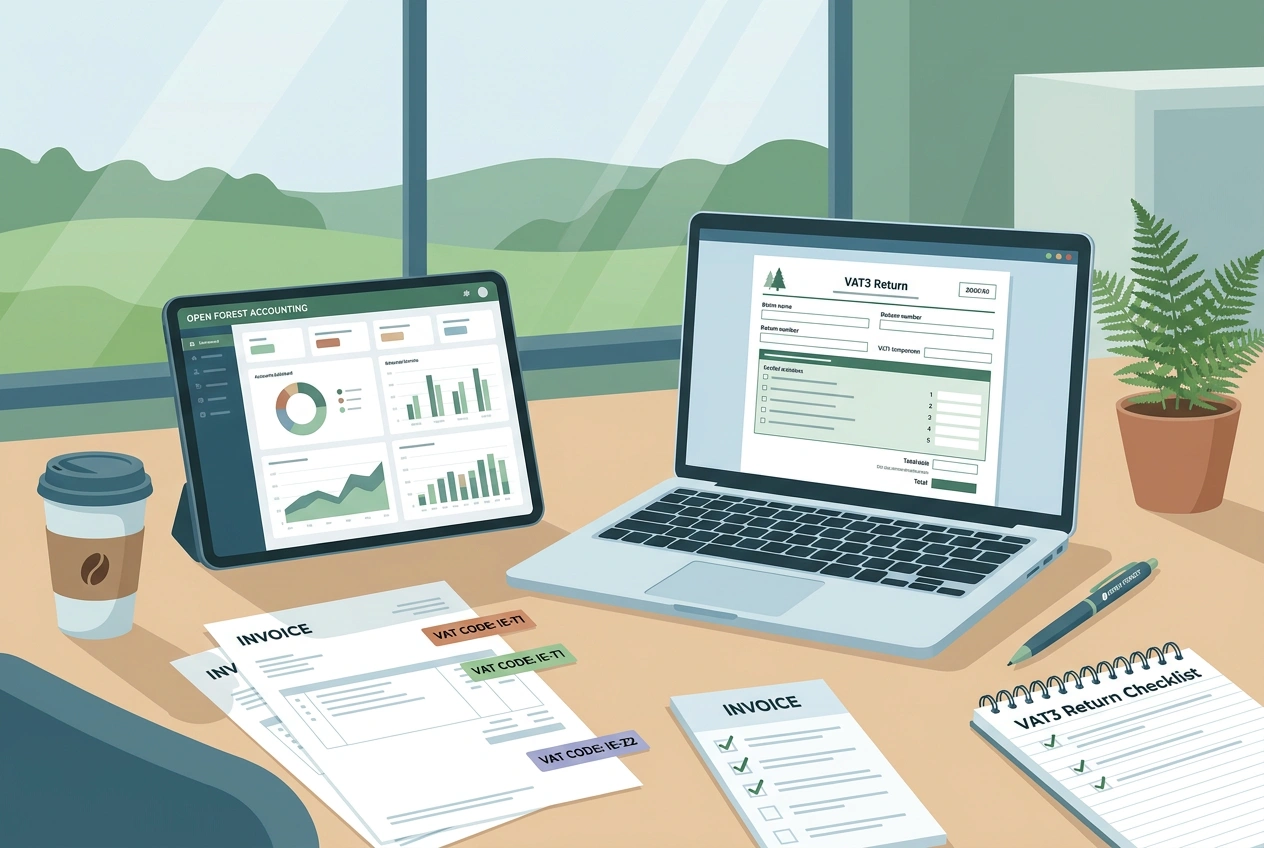
Revenue's checklist for a full VAT invoice is non-negotiable. Each line must be present:
Issue date (the invoice must issue within 15 days of the end of the month in which the supply was made)
A unique, sequential invoice number
Your business name, address, and Irish VAT number
The customer's name, address, and VAT number where required (for example, EU B2B sales)
A clear description of the goods or services supplied
Quantity, unit price, and any discounts shown net of VAT
The VAT rate applied: 23% standard, 13.5% reduced, 9% second reduced, or 4.8% livestock rate
The VAT amount in euro
The total invoice value
Reverse-charge wording where the customer accounts for the VAT (for example, "VAT reverse charge applies under Article 196 of Directive 2006/112/EC")
The Open Forest invoice entry covers the underlying definitions if you want a single-line reference for staff.
Invoices for non-VAT-registered businesses
Below the registration thresholds (€85,000 goods, €42,500 services) you still issue invoices, but the rules are simpler:
The document is a sales invoice, not a VAT invoice
Do not show a VAT number, VAT rate, or VAT amount
Do not use the phrase "VAT" or "VAT-inclusive" anywhere on the document because it might lead to a customer mistakenly reclaiming VAT
Keep the same sequential numbering discipline
Include your business name and address, the customer's details, the supply description, and the total
When you eventually register for VAT , switch invoice templates the day the registration becomes effective. Issuing a non-VAT invoice after the effective date is treated as a non-compliant invoice and forces you to either re-issue or absorb the VAT out of your margin. Read the VAT essentials guide before you cross either threshold.
Simplified Invoices
Not every sale needs the full VAT invoice treatment. Where the total amount including VAT is €100 or less, you can issue a simplified invoice instead.
This carries fewer mandatory fields:
your name
address,
VAT number
the date of issue
a description of the goods or services
the VAT-inclusive amount
the VAT rate applied
You do not need to include the customer's name, address, or VAT number. The trade-off is that a simplified invoice cannot be used for intra-Community supplies, and some larger customers will reject them regardless of the threshold because their own accounts payable process requires full invoice data to support an input VAT claim. If you issue a high volume of low-value transactions, simplified invoicing saves real time, but check with your key customers before switching.
Sequential numbering rules
Revenue expects one unbroken sequence per VAT-registered entity, even if the entity has multiple branches or trading divisions. A few practical points:
Restarting numbers each year is allowed if the prefix or year segment makes the sequence unambiguous (for example INV-2026-0001)
A voided invoice must keep its number and be flagged "VOID" in the system. Do not skip numbers
Lost or destroyed invoices should be re-issued with a clear note linking the new number to the original
Gaps in the sequence are the single most common red flag in a Revenue desk audit
If you use Xero, QuickBooks, or Sage, the platform enforces sequencing automatically. The risk lives in manual templates and parallel quote-to-invoice workflows.
Credit notes and corrections
When you need to undo or adjust an invoice, the rules differ depending on what changed:
A credit note is used when the supply itself is reduced or cancelled (returns, post-supply discounts, billing errors)
An amended invoice is only used before the original has been issued to the customer or recognised in their books
A credit note must include:
The words "Credit Note"
A unique sequential credit note number (separate from the invoice sequence)
A reference to the original invoice number
The reason for the credit
The same supplier and customer details as the original
The VAT rate, VAT amount, and net adjustment
In your books, the credit note hits the same accounts as the original invoice in reverse. On the VAT3, it reduces the relevant T1 line in the period the credit note is issued. The treatment also flows into your annual Return of Trading Details at year-end.
Moving from Sole Trade to Limited Company
A common transition mistake is continuing to invoice the same way after incorporating . The company is a separate legal entity with its own tax registrations, its own VAT number, and its own invoicing obligations. The sole trader's invoices cannot be retroactively re-issued under the company name, and the sole trader's VAT number does not transfer across.
From the date the company begins trading, every invoice must show the company's registered name, a fresh sequential numbering series, and its own VAT number if registered. Any revenue earned before that date belongs to you personally and is reported on your income tax return, not in the company's books.
Electronic invoicing in Ireland
B2B e-invoicing in Ireland is voluntary today, but Revenue has confirmed a three-phase rollout:
1 November 2028. VAT-registered large corporates must issue structured electronic invoices for domestic B2B transactions, with real-time reporting to Revenue. From the same date, every VAT-registered business in Ireland must be able to receive structured e-invoices.November 2029. Phase Two extends the issuing obligation to all VAT-registered businesses engaged in intra-EU B2B trade.1 July 2030. EU VAT in the Digital Age (ViDA) requirements become mandatory across the bloc.
Sending a PDF by email is not a structured e-invoice. The format will be based on the Peppol network. If you are using cloud accounting, your provider will most likely handle the Peppol mapping for you. If you are using spreadsheets or a home-built billing tool, plan the migration this year, not in 2028.
A practical setup for new companies
The fastest way to land a compliant invoicing process is to:
Pick a cloud accounting platform before your first sale
Configure the company details, VAT number, and a default sequence (INV-2026-0001 works well)
Build one template for VAT invoices and one for non-VAT, with the mandatory fields hard-coded
Set up customer records with full address and VAT number once, so each invoice reuses validated data
Reconcile invoices against your bank feed at least monthly so missing or unpaid invoices surface early
Archive every issued invoice in the platform (our document retention guide covers how long)
Treat the template as part of your statutory records . Reviewing it once a year, in line with annual return preparation, catches drift before it becomes a problem.
What to do next
Audit your last twenty invoices against the Revenue checklist this week. Look for missing VAT numbers, broken sequences, and credit notes that reference no original. Fix the template, not the historical invoices, then run the routine for a clean month.
If you would rather hand the setup off, Open Forest can configure your cloud accounting invoicing, build the VAT and credit note templates, and prepare your business for the 2028 e-invoicing changes.