This guide is essential for directors, finance managers, and accountants of Irish companies handling Corporation Tax obligations, especially small and large firms navigating preliminary tax payments.
Readers will learn precise deadlines, calculation methods, penalties for non-compliance, and proven strategies like tax reserves and reliefs to optimize cash flow and ensure Revenue compliance.
Key Takeaways
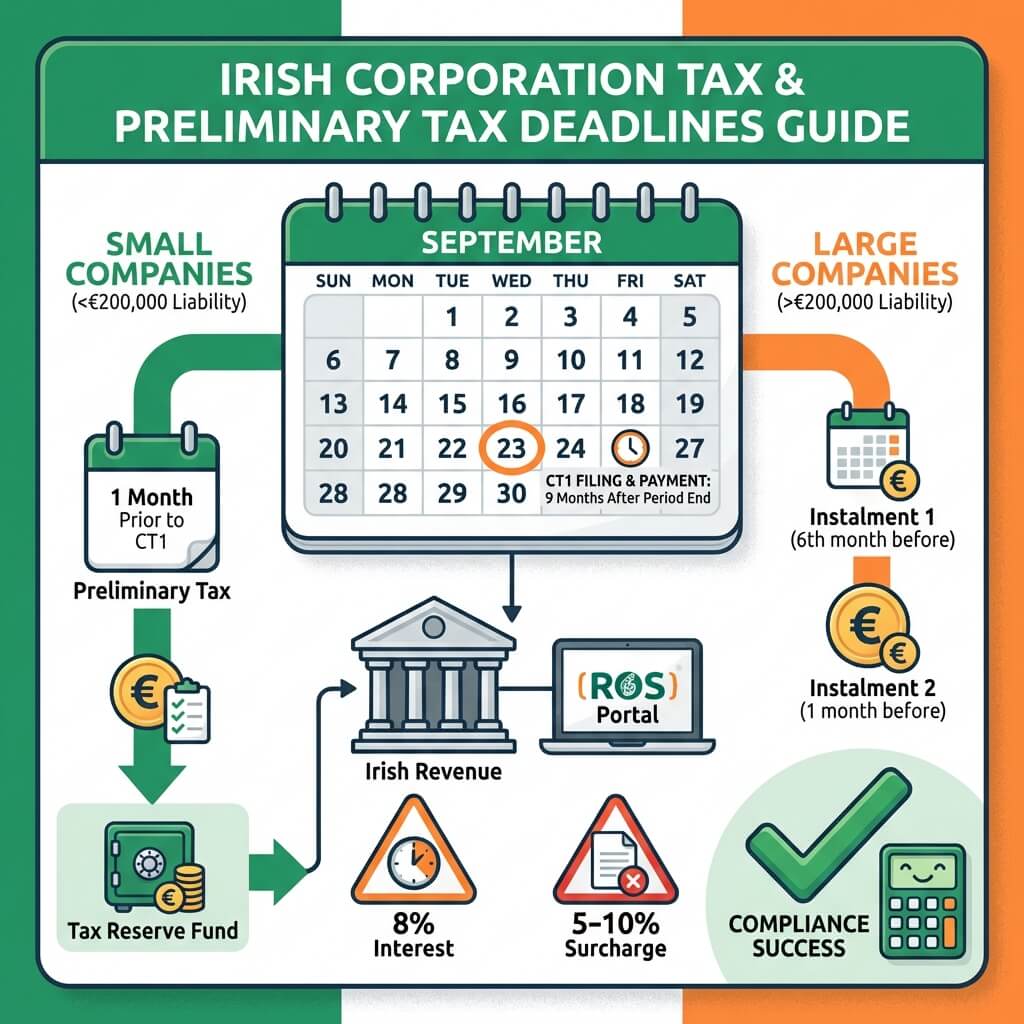
- Corporation Tax returns must be filed by the 23rd day of the 9th month after accounting period end.
- Small companies pay Preliminary Tax one month before period end; large companies in two instalments.
- Preliminary Tax: 90% current or 100% prior year to avoid interest.
- Late filing: 5-10% surcharges; late payment: 8% interest per annum.
- Manage cash flow with forecasting, reserves, professional advice, and relief claims.

Corporation Tax and Preliminary Tax Deadline: A Complete Guide
This comprehensive guide provides essential information on Corporation Tax (CT) and Preliminary Tax obligations under Irish tax law. Understanding these deadlines and requirements is crucial for maintaining compliance with Revenue regulations and avoiding unnecessary penalties and interest charges.
1. Key Filing and Payment Deadlines for Corporation Tax
Corporation Tax Return Filing Deadline
Companies must file their Corporation Tax Return (Form CT1) on or before the 23rd day of the 9th month after the accounting period end. All deadlines quoted assume filing and payment via ROS (Revenue Online Service).
Example: For an accounting period ending 31 December 2025, the CT1 return must be filed, and outstanding liability must be paid, by 23rd September 2026.
Corporation Tax Payment Deadline
The payment deadline for CT for any outstanding liability is also the 23rd day of the 9th month after the year end. This is the liability calculated for the given year, less any preliminary tax paid from the prior year.
2. Understanding Preliminary Tax Requirements and Calculation
What is Preliminary Tax?
Preliminary Tax is basically your company's best guess at how much Corporation Tax it will owe for the current year's accounts. Instead of paying everything at the end when you file your tax return, you make payments in advance during the year. Once the actual tax amount is calculated, these advance payments are subtracted from what you owe. If you've paid too much, Revenue will give your company a refund.
Preliminary Tax for a Small vs Large Companies
For Irish Corporation Tax, “small” and “large” company status impacts its preliminary tax obligations and payment timing.
Small Companies
A Small company has a CT liability for the preceding accounting period of €200,000 or less.
Preliminary Tax can be based on either of:
- 100% of the preceding period’s CT liability (preceding year basis), or
- 90% of the current period’s CT liability (current year basis, with top up later if needed).
The 100% of the prior year is typically the safer option provided that profits are not decreasing as it provides certainty over the amount payable.
The Preliminary Tax payment deadline for payments made online is the 23rd of the month prior to the company’s accounting period end.
Large company
A Large Company is a company that has a CT liability for the preceding accounting period of more than €200,000.
The first instalment is as follows:
First instalment
The amount payable is:
- 50% of the CT liability for the previous accounting period, or
- 45% of the CT liability for the current accounting period.
It is due on the earlier of:
- The last day within 6 months from the start of the accounting period, or
- The 23rd day of the month containing that day.
Second instalment:
The amount due is the balance that will bring the preliminary tax up to 90% of the final tax due for the current accounting period. It is due to be paid on the 23rd day of the 11th month of the accounting period.
3. Consequences of Late Filing or Payment
Interest on Late Payment
Interest is charged on late or underpaid Corporation Tax at a daily rate, currently set by Revenue. The interest rate is 8% per annum. (0.0219% daily). Interest accrues from the due date for payment until the date payment is made.
Surcharge for Late Filing
A surcharge is automatically applied if the Corporation Tax return (Form CT1) is filed late. The surcharge is calculated as follows:
Time Period Surcharge Rate
Return filed within 2 months of deadline 5% of tax due
Return filed more than 2 months late 10% of tax due
The surcharge is calculated on the amount of tax due, subject to a maximum of €12,695 per return for within 2 months late and €63,485 if more than 2 months late.
Restriction of Loss Relief
Companies that file their Corporation Tax returns late may face restrictions on claiming certain loss reliefs and capital allowances. Specifically:
- Group relief claims may be restricted or denied
- Trading losses carried forward may be restricted
- Capital allowances may be reduced
Publication of Tax Defaulters
Revenue publishes a quarterly list of tax defaulters. Companies may be published if the aggregate settlement (tax, interest and penalties) exceeds Revenue’s publication thresholds, and no qualifying disclosure has been made. Publication can damage business reputation and affect relationships with customers and suppliers.
Inability to Obtain Tax Clearance
Companies with outstanding tax liabilities or unfiled returns cannot obtain a Tax Clearance Certificate. This certificate is required for:
- Certain public sector contracts
- Licences and permits (e.g., liquor licences, PSV licences)
- State grants and incentives
4. Strategies to Manage Tax Cash Flow Effectively
Accurate Tax Forecasting
Develop robust financial forecasting to estimate Corporation Tax liabilities well in advance. This includes:
- Regular management accounts (monthly or quarterly)
- Profit forecasts updated throughout the year
- Tax computations prepared in advance of deadlines
Establish a Tax Reserve Fund
Set aside funds monthly to cover anticipated tax liabilities. A recommended approach is to transfer a percentage of monthly profits into a designated tax reserve account. This ensures funds are available when Preliminary Tax instalments and final payments are due.
Use the Prior Year Method Strategically
For small companies with fluctuating profits, paying Preliminary Tax based on 100% of the prior year’s liability provides certainty and avoids the risk of underpayment. While this may result in overpayment in a declining profit year, it eliminates interest risk and is recovered when the return is filed.
Consider Phased Payment Plans
If a company experiences cash flow difficulties, Revenue may agree to a phased payment arrangement. This must be:
- Requested proactively before the payment deadline
- Supported by detailed financial information
- Accompanied by a realistic repayment proposal
Note: Revenue will continue to charge interest on the outstanding balance under a phased payment arrangement, so this option is generally reserved for cases of significant cash flow pressure
Maximise Available Tax Reliefs and Credits
Ensure your company claims all available reliefs and credits to reduce the overall tax liability. Common reliefs include:
- Research and Development (R&D) Tax Credit
- Capital allowances on plant and machinery
- Start-up relief for new companies (relief from corporation tax in the first five years, subject to liability limits of €40,000-€60,000 per year)
- Knowledge Development Box relief (reduced rate on profits from qualifying intellectual property)
Engage Professional Tax Advisors
Tax legislation is complex and changes regularly. Engaging qualified accountants and tax advisors ensures:
- Compliance with all filing and payment obligations
- Optimisation of tax position and cash flow
- Early identification of potential issues
- Access to specialist knowledge on complex transactions
Review Accounting Period Alignment
Consider whether your accounting period end date optimally aligns with your business cash flows. While 31 December is common, some businesses benefit from alternative year-ends that better match their trading cycle and cash collection patterns.
Conclusion
Compliance with Corporation Tax and Preliminary Tax requirements is a fundamental obligation for Irish companies. Understanding the deadlines, calculation methods, and consequences of non-compliance is essential for effective tax management.
Key takeaways:
- Corporation Tax returns must be filed within 9 months of the accounting period end
- Small companies (≤€200,000 liability) pay 1 month before period end; large companies pay via Preliminary Tax instalments
- Preliminary Tax must be paid at 90% of current year or 100% of prior year to avoid interest
- Late filing attracts surcharges of 5% or 10%, and late payment attracts interest at 8% per annum
- Effective cash flow management through forecasting, reserves, and professional advice prevents compliance issues
Companies that implement proper tax planning, maintain accurate records, and meet all deadlines will avoid penalties, preserve reliefs, and maintain positive relationships with Revenue. When in doubt, always seek professional advice to ensure full compliance with Irish tax legislation.
Disclaimer
This guide is for general information purposes only and does not constitute professional tax advice. Tax legislation is subject to change, and individual circumstances vary. Companies should consult with qualified tax advisors or accountants for advice specific to their situation. This document is based on Irish tax law as of February 2026.

Paul Burke is a qualified ACA and CTA tax accountant in Ireland.He trained at Forvis Mazars in Galway, gaining experience in various tax heads including Income Tax, Corporation Tax, VAT, Payroll and Tax Advisory.He is now a Tax Consultant in a local tax firm.