UK business owners including sole traders, partnerships, and limited company directors approaching or exceeding the £90,000 VAT threshold, or non-UK businesses supplying to the UK.
Readers will gain a clear step-by-step registration process, document checklists, scheme options, benefits/drawbacks, penalty avoidance tips, and post-registration obligations for seamless HMRC compliance.
Key Takeaways
- Register for VAT if VAT-taxable turnover exceeds £90,000 in 12 months or expected soon; do so within specified 30-day windows.
- Gather business-specific documents like UTR, NI number, Companies House details before online application via HMRC portal.
- Choose suitable schemes: Annual, Flat Rate, or Cash Accounting to fit your business model and cash flow.
- Benefits include VAT reclaim on purchases and B2B credibility; drawbacks are added costs for non-VAT customers and compliance.
- Post-registration: keep digital MTD records, file returns; certificate arrives in 30 days.

The Founder’s Guide to Registering for VAT in the UK
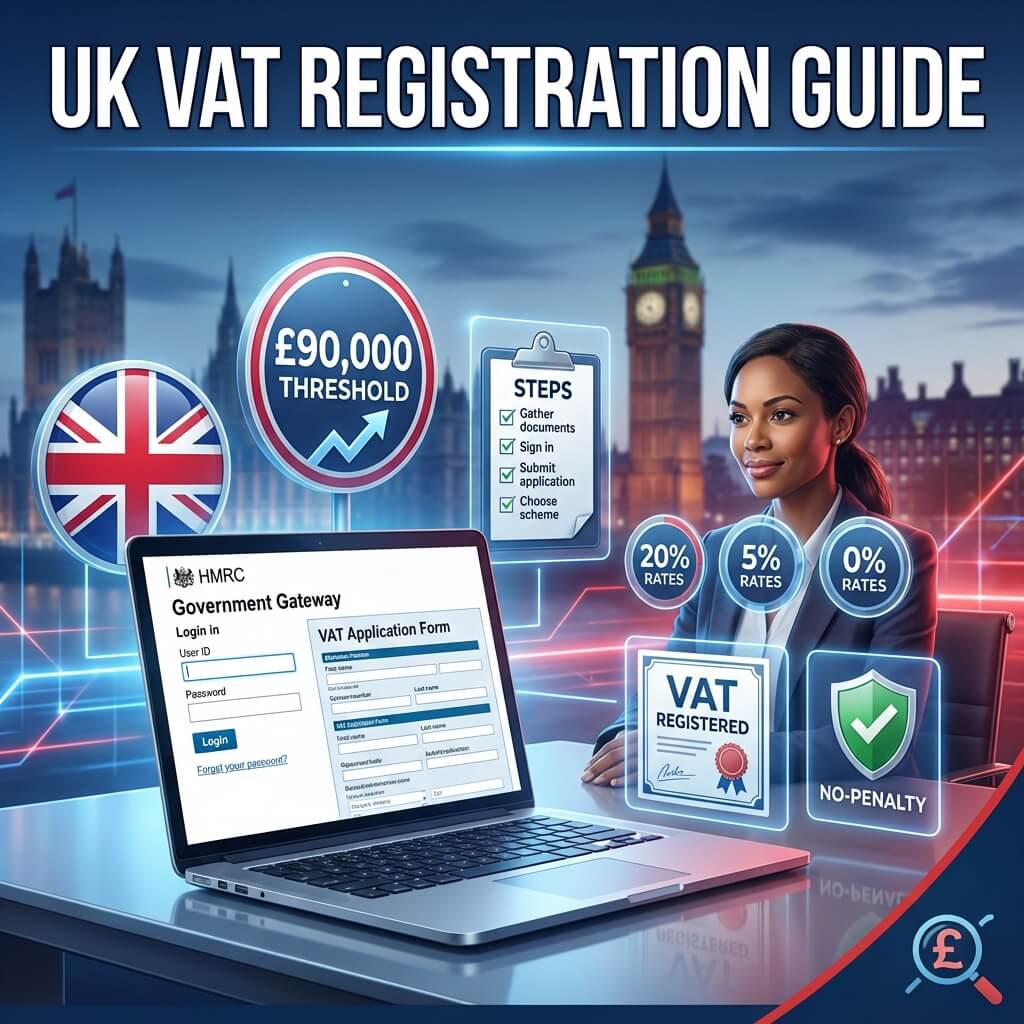
If you run a business in the UK, understanding when and how to register for VAT is one of the most important compliance steps you will face. VAT (Value Added Tax) applies to most goods and services sold in the UK. Once your VAT-taxable turnover crosses the current threshold of £90,000, registration is not optional. It is a legal requirement.
Getting it right from the start saves you from penalties and puts you in a stronger position to manage your finances. This guide walks you through the entire process, from checking whether you need to register to choosing the right VAT scheme for your business. Everything here is based on the current rules for the 2026/27 tax year.
What Is VAT and Why Does It Matter?
VAT is a consumption tax added to the price of most goods and services in the UK. When a customer buys from your business, you collect VAT on behalf of HMRC. Three rates currently apply:
- Standard rate (20%) — covers most goods and services.
- Reduced rate (5%) — applies to specific items such as children's car seats and home energy.
- Zero rate (0%) — applies to most food, books, and children's clothing.
Some items are exempt from VAT entirely, such as postage stamps and financial services. The rules can shift too. From 1 January 2025, private school fees became subject to the standard 20% rate.
Being VAT-registered also means you can reclaim the VAT you pay on your own business purchases. This is the difference between your output tax (what you charge customers) and your input tax (what you pay suppliers).
When Must You Register for VAT?
You are legally required to register for VAT when any of these apply:
- Your VAT-taxable turnover exceeds £90,000 in any rolling 12-month period.
- You expect your turnover to exceed £90,000 in a single 30-day period.
- Your business is based outside the UK but you supply goods or services to the UK (or expect to within the next 30 days).
If you cross the threshold in a rolling 12-month period, you must register within 30 days of the end of the month you exceeded it. Your effective date of registration is the first day of the second month after you went over.
If you expect to exceed the threshold in the next 30 days, you must register by the end of that 30-day window. Your effective date of registration is the day you formed that expectation.
Penalties for Late Registration
Failing to notify HMRC on time can be costly. Under the current penalty regime, a 3% charge applies to tax that is 15 days overdue. This rises to 6% after 30 days. A further 10% per annum penalty accrues daily after that point.
Author's tip: Keep a running total of your VAT-taxable turnover each month. A simple spreadsheet or accounting tool that flags when you approach £90,000 can prevent a missed deadline and an unwelcome penalty.
Benefits and Drawbacks of VAT Registration
Registration is not all burden. There are genuine advantages, especially for businesses that trade with other VAT-registered companies.
Benefits
- You can reclaim VAT on eligible business purchases, improving your cash flow.
- In B2B transactions, VAT charges are standard practice. Other businesses simply reclaim what you charge.
- A VAT number on your invoices signals credibility and scale. Some larger companies prefer to work only with VAT-registered supplier
Drawbacks
- Customers who are not VAT-registered (such as the general public) bear the full cost of the added VAT, which may make your prices less competitive.
- If you charge more VAT than you pay on purchases, you must pay the difference to HMRC.
- You must keep detailed digital records and file regular returns that comply with Making Tax Digital (MTD) rules.
What You Need Before You Register for VAT
Gather the right documents before you start. What you need depends on your business type.
Limited Companie
- Company legal name and Companies House registration number
- Business contact details and bank details
- Unique Taxpayer Reference (UTR) for Corporation Tax
- Details of turnover and business activities
Sole Traders and Partnership
- Your name, date of birth, and National Insurance number
- ID such as a passport or driving licence
- Business contact details and bank details
- Self Assessment UTR (if you have one)
How to Register for VAT Online: Step by Step
- Prepare your documents. Gather everything listed above for your business type.
- Sign in to the HMRC website. Use your Government Gateway ID. If you do not have one, you can create one during this step.
- Select VAT. Navigate to "Get another tax, duty or scheme" and choose VAT.
- Complete the application. Fill in your business details as prompted by the portal.
- Submit and wait. HMRC typically processes applications within 10 working days.
- Receive your VAT certificate. This arrives by post within 30 days. It contains your VAT number and tells you when to submit your first return.
HMRC has made online registration mandatory for most businesses. A paper VAT1 form is available only in specific circumstances, such as applying for an exemption. You would need to call the VAT general enquiries helpline to request one.
Choosing the Right VAT Accounting Scheme
When you register, you can opt into a VAT scheme that suits your business model.
Annual Accounting Scheme
You submit one VAT return per year instead of quarterly. You still make regular advance payments throughout the year based on an estimate of your liability.
Flat Rate Scheme
You pay a fixed percentage of your total turnover to HMRC rather than calculating the exact difference between output and input tax. The percentage depends on your industry. This can benefit businesses with low costs.
Cash Accounting Scheme
You account for VAT based on when you receive payment, not when you issue an invoice. This protects your cash flow because you do not pay HMRC on money you have not yet collected.
What Happens After You Register?
You should receive your VAT certificate within 30 working days. If you have not heard from HMRC in that time, contact them to check progress.
Your obligation to account for VAT starts from your effective date of registration, not the date you completed the online form. Under Making Tax Digital rules, you must keep digital records and submit returns using MTD-compatible software.
Conclusion
Registering for VAT is a straightforward process once you know what to expect. Gather your documents, complete the HMRC online application, and choose the accounting scheme that fits your business. Staying on top of your VAT obligations from day one protects you from penalties and keeps your finances in order.

Stuart Connolly is a corporate barrister in Ireland and the UK since 2012.
He spent over a decade at Ireland's top law firms including Arthur Cox & William Fry.