This article is for non‑resident entrepreneurs and founders who are deciding where to incorporate their business, as well as legal or financial advisors helping such clients choose between an Irish LTD and a UK Ltd. It is especially relevant if you need to weigh EU single‑market access, director residency requirements, and cost implications.
After reading, you will understand the key distinctions in market access, tax rates, formation fees, and director‑resident rules for Irish and UK companies. You will be able to compare the practical advantages of each jurisdiction and make an informed decision about which structure best fits your business goals and compliance needs.
Key Takeaways
- Choosing between an Irish LTD and a UK Ltd hinges on whether you need full EU single‑market access, which an Irish company provides, versus the simpler director residency rules of a UK company.
- Irish LTDs require at least one EEA‑resident director or a Section 137 bond for non‑EEA founders, while UK Ltds have no residency requirement for directors.
- Corporation tax rates differ: Irish LTDs charge a flat 12.5% on trading profits, whereas UK Ltds apply 19% up to £50,000 profit and 25% above £250,000, with marginal relief in between.
- Both formations are low‑cost and fast—about €50 and five days for Ireland, £100 and within 24 hours for the UK—but the decisive factors are market access, tax structure, and director residency obligations.
Brexit materially changed one thing affecting company formation decisions: the United Kingdom is now outside the EU single market, and Ireland is the only English-speaking, major common-law country left inside it. For a founder who lives somewhere else and wants a credible European base, that single fact reframes the whole Ireland vs UK company formation decision. Both countries give you a fast, low-cost private limited company with limited liability, so the real choice is about market access, how your profits are taxed, and the rules on who must sit on your board. This guide compares an Irish LTD and a UK Ltd on setup, cost, tax, director residency, and the beneficial-ownership rules, so a non-resident founder can pick the base that matches where the business actually trades.
Why does Ireland vs UK company formation come down to EU access?
The defining difference in Ireland vs UK company formation is the EU single market: an Irish company sells freely into a market of more than 400 million consumers, while a UK company now trades with the EU as a third country. Since the UK left the single market on 1 January 2021, goods, services, and data crossing the border face customs, regulatory, and paperwork friction that an Irish company simply does not meet inside the bloc.
Ireland has used the euro since 1999 and shares the EU's regulatory regime, which matters if your customers, suppliers, or investors are in Europe. The UK keeps its own strengths: the English language, English law, the City of London's capital, and an independent network of trade deals. The same trade-off sits behind any choice of business structure in Ireland: pick the base that matches your market, not just the lowest number on a rate card.
Please note: Neither a low tax rate nor a prestigious address makes a company tax-resident on its own. Where your directors meet and your real decisions are made can move tax residency, so treat this as a structure decision first and a rate decision second.

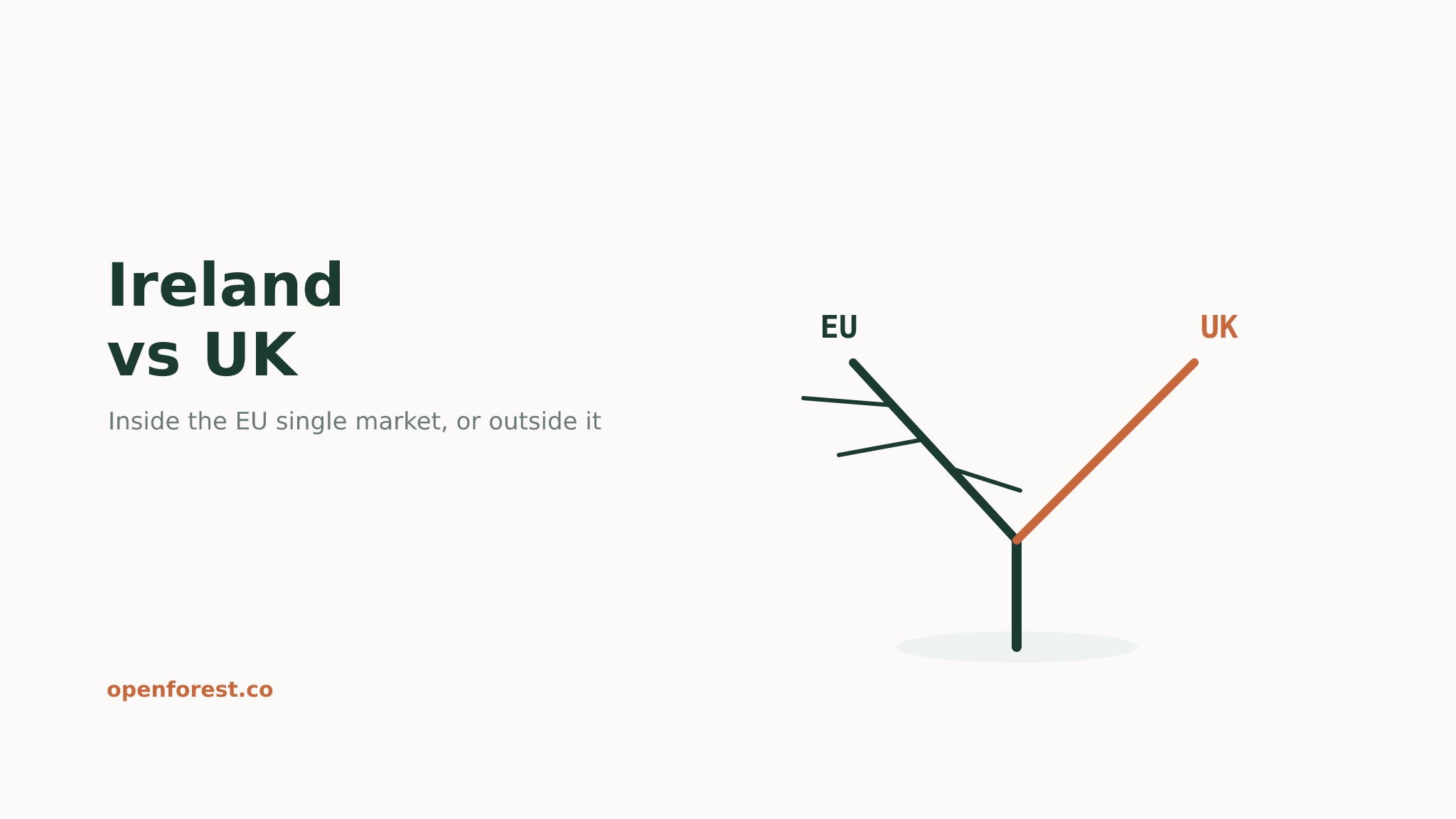
Figure 1: the post-Brexit split, an Irish LTD inside the EU single market against a UK Ltd trading with the EU as a third country.
What is an Irish LTD, and how do you set one up?
An Irish LTD is a private company limited by shares with no minimum share capital, formed by filing with the Companies Registration Office (CRO) rather than in front of a notary. Most founders issue a small amount of share capital, commonly between 1 euro and 100 euro, and that is enough to incorporate.
You submit a single constitution and a Form A1 to the CRO through its online CORE portal for a 50 euro electronic fee, and the Fe Phrainn scheme targets a Certificate of Incorporation within five working days. For the full breakdown, see the cost to register an Irish company.
Once live, the company pays corporation tax at 12.5 percent on trading profit and 25 percent on passive income such as rent or investment returns. It must keep at least one director, a company secretary, and a registered office in Ireland, and at least one director must be resident in the European Economic Area (EEA). That EEA rule is where non-resident founders meet an extra step, covered below.
What is a UK Ltd, and how does it differ?
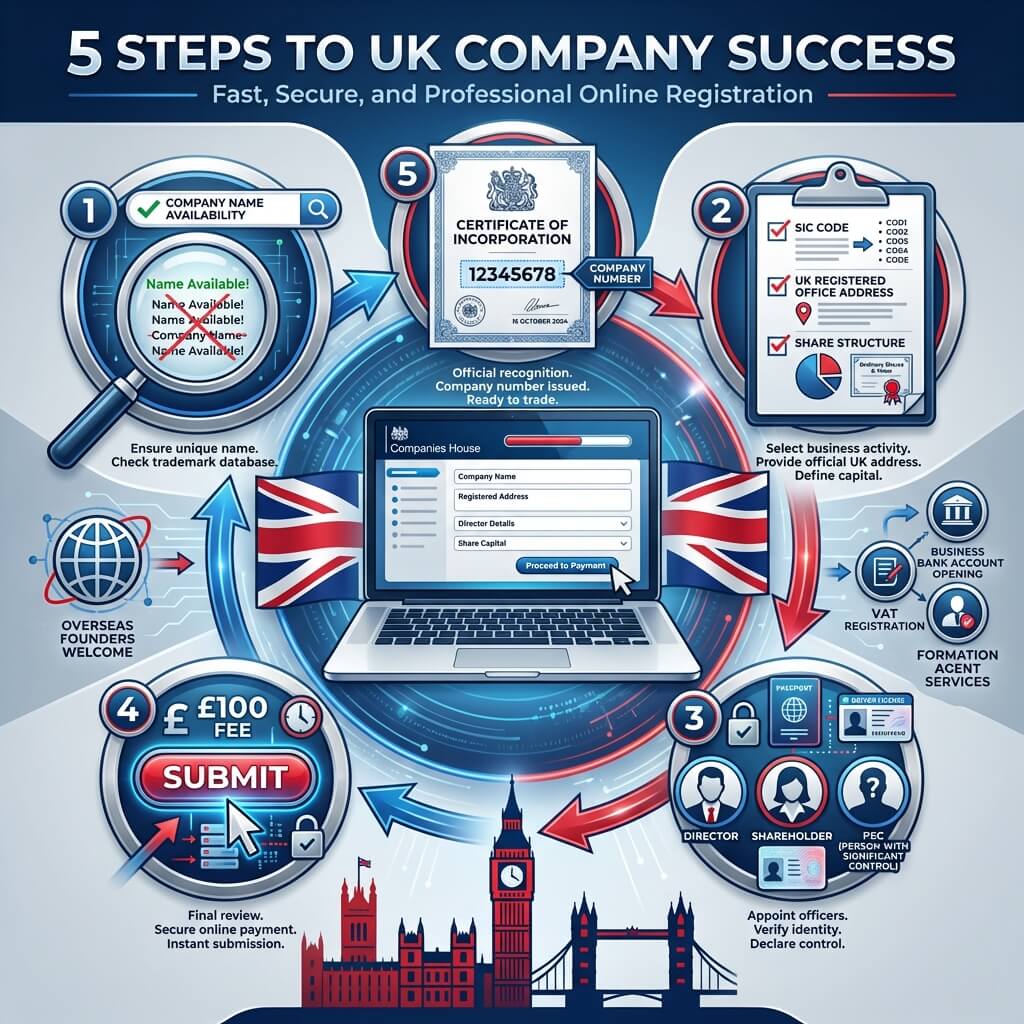
A UK Ltd is a private company limited by shares registered with Companies House, with no minimum share capital and no requirement for any director to be UK-resident. You need at least one director who is a natural person aged 16 or over, at least one share issued (commonly a single 1 pound share), a UK registered office, and at least one person with significant control recorded on the register.
Setup is quick and cheap. Companies House usually registers a new company within 24 hours of an online application, and since 1 February 2026 the digital incorporation fee is 100 pounds. The headline corporation tax position is more layered than Ireland's flat rate: a main rate of 25 percent applies to profits above 250,000 pounds, a small profits rate of 19 percent applies to profits up to 50,000 pounds, and marginal relief tapers the rate in between.
The key difference is: an Irish LTD opens the EU single market at a flat 12.5 percent trading rate but needs an EEA-resident director, while a UK Ltd has no director-residency rule and a low 19 percent small-profits rate, but it trades with the EU from outside the single market.
Ireland vs UK company formation: cost, time and tax compared
On entry cost the two are close: no meaningful minimum capital, low filing fees, and formation measured in days. The sharper differences are EU access, the shape of the tax, and the director rule, not the speed of setup.
The table sets the two side by side on the points non-resident founders ask about most.
FeatureIrish LTDUK LtdEU single market accessYes, full memberNo, trades as a third countryCurrencyEuroPound sterlingMinimum share capitalNone (1 to 100 euro common)None (1 pound share common)Registration bodyCRO (online CORE portal)Companies House (online)Cost to fileAbout 50 euro100 pounds (since 1 Feb 2026)Typical time to formAbout 5 working daysUsually within 24 hoursCorporation tax12.5 percent trading, 25 percent passive19 percent up to 50,000 pounds, 25 percent above 250,000 poundsResident director ruleOne EEA-resident director (or a bond)NoneBeneficial ownership registerRBO (Central Register)PSC register (Companies House)
Irish LTD vs UK Ltd on setup, cost, tax and director rules, 2026.

Figure 2: corporation tax compared, the Irish flat 12.5 percent trading rate against the UK small-profits and main rates.
It is important to note that the UK's 19 percent rate only holds at low profit, climbing toward 25 percent as profits pass 50,000 pounds, so a growing company loses the rate advantage. On the Irish side, the 25 percent rate on passive income narrows the gap for a company that mostly holds investments rather than trades. Both systems reward genuine activity, not a nameplate.
Start your Irish company in days, not weeks
Open Forest forms your Irish LTD online, with the constitution, director and secretary roles, and registered office handled for you, then keeps the filings on track afterwards.
Register your Irish company and start trading inside the single market.
What are the director and ownership rules for non-resident founders?
The biggest practical gap in Ireland vs UK company formation is who must sit on the board. Ireland wants a local anchor, while the UK does not.
Ireland requires at least one director resident in the EEA. If your board has no EEA-resident director, Irish law requires a Section 137 bond worth 25,000 euro for a two-year term, which costs roughly 1,500 to 2,000 euro to buy. So an EEA-resident founder needs nothing extra, while a founder outside the EEA pays for a bond but still keeps full control. Our guide to non-resident directors in Irish companies walks through the options, and you can also read the wider picture for Irish companies for non-residents.
The UK sets no residency bar at all, a non-resident founder can be the sole director of a UK Ltd without a bond or a nominee, which is genuinely simpler on paper. The trade-off shows up elsewhere: both countries run a public beneficial-ownership register (the UK's PSC register and Ireland's RBO), and a UK company with no local presence often finds banking and tax-residency questions harder, not easier. Where a UK founder might instead want an Irish base, see Irish company formation for UK residents.

Figure 3: the director-residency rule compared, the Irish EEA test and Section 137 bond against the UK's no-residency rule.
Author's tip: Price the director rule before you choose. An EEA-resident founder pays nothing extra for an Irish LTD, a non-EEA founder pays once for a two-year bond, and a UK Ltd avoids the rule entirely, so weigh that one-off bond against losing single-market access.
Which should you choose, Ireland or the UK?
Choose the Irish LTD when your customers, suppliers, or investors are in Europe, and choose the UK Ltd when your market is mainly in Britain or you want the lighter director rules, because the right base follows where the business actually trades. Tax rate is a tie-breaker, not the headline.
In our experience, substance decides whether either rate sticks. A company is generally tax-resident where its real control and management sits, so an Irish company run day to day from abroad, or a UK company whose decisions are made elsewhere, can be pulled into another country's tax net under the relevant double tax treaty. Genuine local decision-making is what protects your tax residency, so build the structure where you can actually run it.
If you sell into the EU and can put real decision-making in Ireland, the LTD is the stronger base, and an EEA-resident founder skips the bond entirely. If your market is the UK, or you value having no resident-director rule, the UK Ltd is the lighter setup, with single-market access as the price you give up.

Figure 4: a short decision map for choosing between an Irish LTD and a UK Ltd as a non-resident founder.
What to do next
Ireland vs UK company formation comes down to one question: do you need to be inside the EU single market or not? Ireland buys you full European access at a flat 12.5 percent, with an EEA-resident director or a one-off bond, while the UK offers a faster, residency-free setup that now trades with Europe from the outside.
Your single most important next step is to confirm where the company will actually be managed, because that drives your tax residency and whether the headline rate holds. Once that is clear, Open Forest can incorporate your Irish LTD in days, put the EEA-resident director, company secretary, and registered office in place, and keep your CRO and Revenue deadlines on one compliance calendar, so the structure stays sound long after formation day.

Laura Ryan is a practising Barrister at the Bar of Ireland. She graduated from the Honourable Society of King’s Inns in 2024, having previously qualified and practised as a Chartered Accountant in a big four accounting firm.