UK residents and overseas entrepreneurs planning to form a limited company for trading in the UK, especially solo founders without a UK address.
They'll get a clear, actionable 5-step guide, understand fees/requirements, benefits of agents, and essential next steps to start operating legally.
How to Start a UK Company: A Step-by-Step Guide You can register a UK limited company online in about 10 minutes, with no visit to the UK required. Whether you're a resident or based overseas, the steps are identical. This guide walks you through each one: picking a name, gathering your details, submitting the application, and getting your certificate of incorporation.
What Is Companies House? Companies House is the UK's official company registrar. Every limited company must be registered here before it can trade. There's no alternative.
Once formed, your company appears on the Companies House public register. Anyone can search it and find basic details about your company, including its officers and registered address.
You don't have to apply directly. Many founders use an accountant or a formation agent to handle registration. This can speed things up and give you access to extra services like a registered office address.
Why Use a Formation Agent? You can submit directly to Companies House, but a formation agent offers practical advantages, especially if you're overseas or want to keep your personal address off the public register.
Registered address services. Every UK company needs a UK-based registered office address. If you don't have one, a formation agent can provide a professional London address for your registered office and director service address. For example, services like these typically cost between £30 and £100 per year depending on the provider.
Confirmation statement filing. Every company must file a confirmation statement at least once a year. The digital filing fee is £50. This confirms the details on the public register are correct. A formation agent can file it for you, cutting admin and avoiding missed deadlines.
VAT registration support. As of April 2026, your company must register for VAT if turnover exceeds £90,000 in a 12-month period. Even below that threshold, voluntary registration can be worthwhile. A formation agent can handle this process for you.
Tip: Voluntary VAT registration lets you reclaim VAT on business purchases. It also adds credibility, as many larger firms prefer working with VAT-registered suppliers.
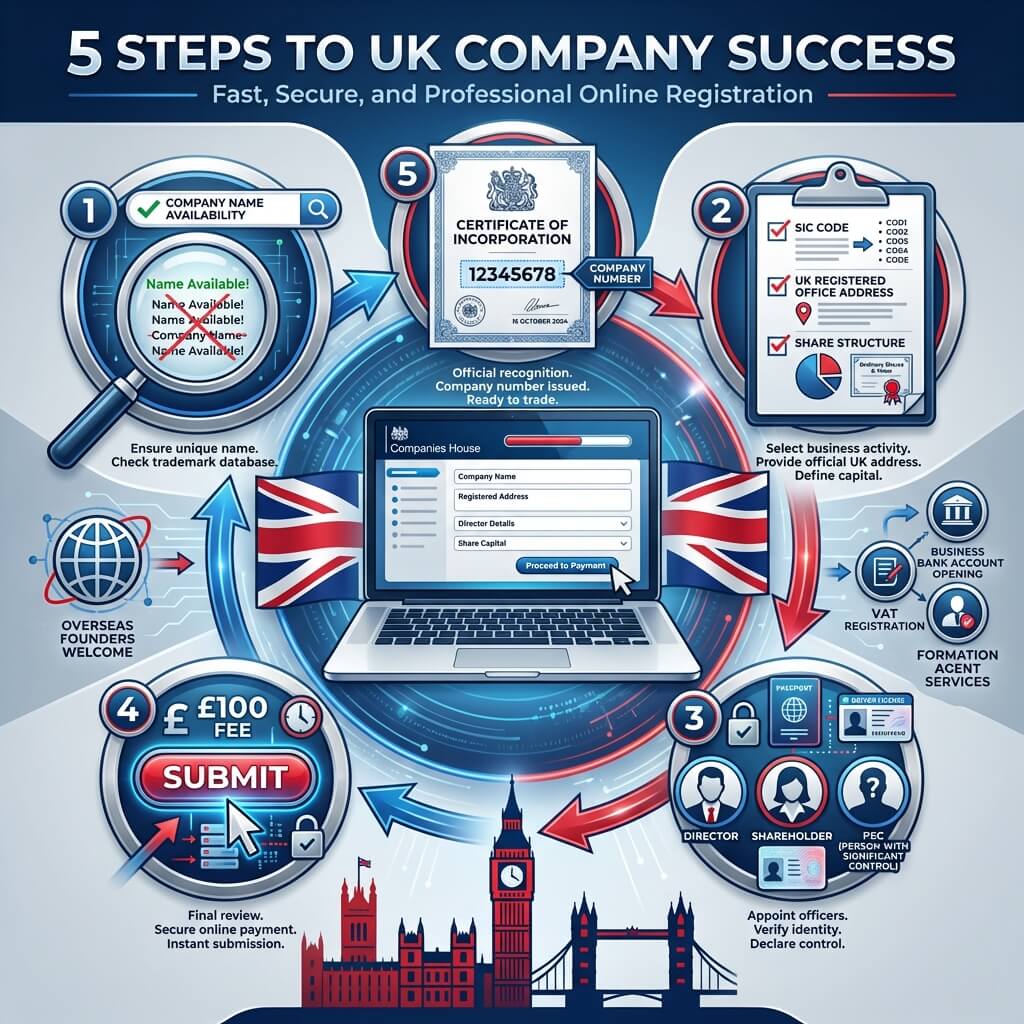
Step 1: Choose Your Company Name Your name must be unique. It can't match or be too similar to an existing name on the Companies House register.
Check availability for free using the Companies House name checker . Most formation agents also offer this tool. Run a quick search before you commit. It takes seconds and saves you from a rejected application.
A few rules to keep in mind: your name can't contain sensitive words (like "Royal" or "Bank") without approval, and it must end with "Limited" or "Ltd" for a private limited company .
Step 2: Gather Your Company Details You'll need three pieces of company information before you start:
A SIC code. This is a Standard Industrial Classification code that identifies your industry. You don't need to look it up in advance. You'll pick from a list during the application. For instance, a consulting firm would typically select code 70229 (management consultancy activities).
A registered office address. This must be a physical UK address. Companies House and HMRC will send all official correspondence here. If you don't have a UK address, a formation agent can supply one.
Your share structure. Most single-founder companies issue one ordinary share with a nominal value of £1. You can set this up differently, but one share at £1 is the simplest starting point.
Step 3: Prepare Your Officer Details You must appoint at least one director, one shareholder, and one person with significant control (PSC). A single person can fill all three roles. This is common for solo founders.
For each officer, you'll need:
Full name Date of birth Nationality Occupation Residential address A service address (the address shown on the public register, which can differ from your home address) Shareholders must state the number, currency, and nominal value of their shares. PSCs must confirm the nature of their control. The application form explains both requirements as you go.
Step 4: Submit Your Application With everything ready, the application itself takes minutes. Enter your company and officer details into the online form, either through Companies House directly or through your formation agent's portal.
As of February 2026, the fee for online registration through Companies House is £100. Paper applications cost £124 and take longer. If you need same-day incorporation, the digital fast-track service costs £156. Most formation agents include the £100 filing fee in their package price.
All directors and persons with significant control must now complete identity verification as part of the application. This was introduced under the Economic Crime and Corporate Transparency Act and applies to both UK and overseas applicants.
Review everything before you hit submit. Correcting errors after incorporation means filing additional paperwork with Companies House.
Step 5: Receive Your Certificate of Incorporation Most online applications are approved within 24 hours. Once approved, you'll receive:
A certificate of incorporation (your company's "birth certificate") Your company's unique registration number A company authentication code for future filings with Companies House Your company is now live on the register and legally able to trade.
What to Do After Incorporation Registration is just the starting point. Here's what you'll need to handle next:
Register for Corporation Tax. You must register with HMRC within three months of starting to trade (not three months from incorporation). Trading includes invoicing clients, advertising, or buying stock. This is separate from company formation and is done through the HMRC website.
Open a business bank account. UK banks require your certificate of incorporation and proof of identity. Some banks let overseas founders open accounts remotely. Tide, Starling, and Wise are popular choices for new companies.
Set up accounting. Your company must file annual accounts with Companies House and a Corporation Tax return with HMRC. Many founders appoint an accountant at this stage, though it's not legally required.
Consider VAT registration. If you expect turnover above £90,000, registration is mandatory. Below that, it's optional but often beneficial for B2B companies.
Getting Started Starting a UK company is a quick, fully online process. With your details ready, the application takes about 10 minutes and approval typically follows within a day.