This article is for Irish company directors, secretaries, and business owners who need to understand their legal obligations around the Register of Beneficial Owners.If you're wondering who needs to file, what information is required, or how to stay compliant with RBO deadlines, this guide covers the complete filing process, who qualifies as a beneficial owner, and what happens if you don't comply.
Key Takeaways
- All Irish companies must file beneficial ownership details within five months of incorporation, then update within 14 days of any changes.
- A beneficial owner is any natural person who owns or controls at least 25% of shares, voting rights, or ownership interest.
- Non-compliance with RBO requirements is a criminal offence carrying potential fines up to €500,000 upon conviction on indictment.
- Directors and company secretaries remain personally liable for accurate RBO filing even when using accountants or agents as presenters.
- The public can access limited beneficial owner information through RBO reports, while authorities receive unrestricted access for enforcement purposes.

What Is the Register of Beneficial Owners?
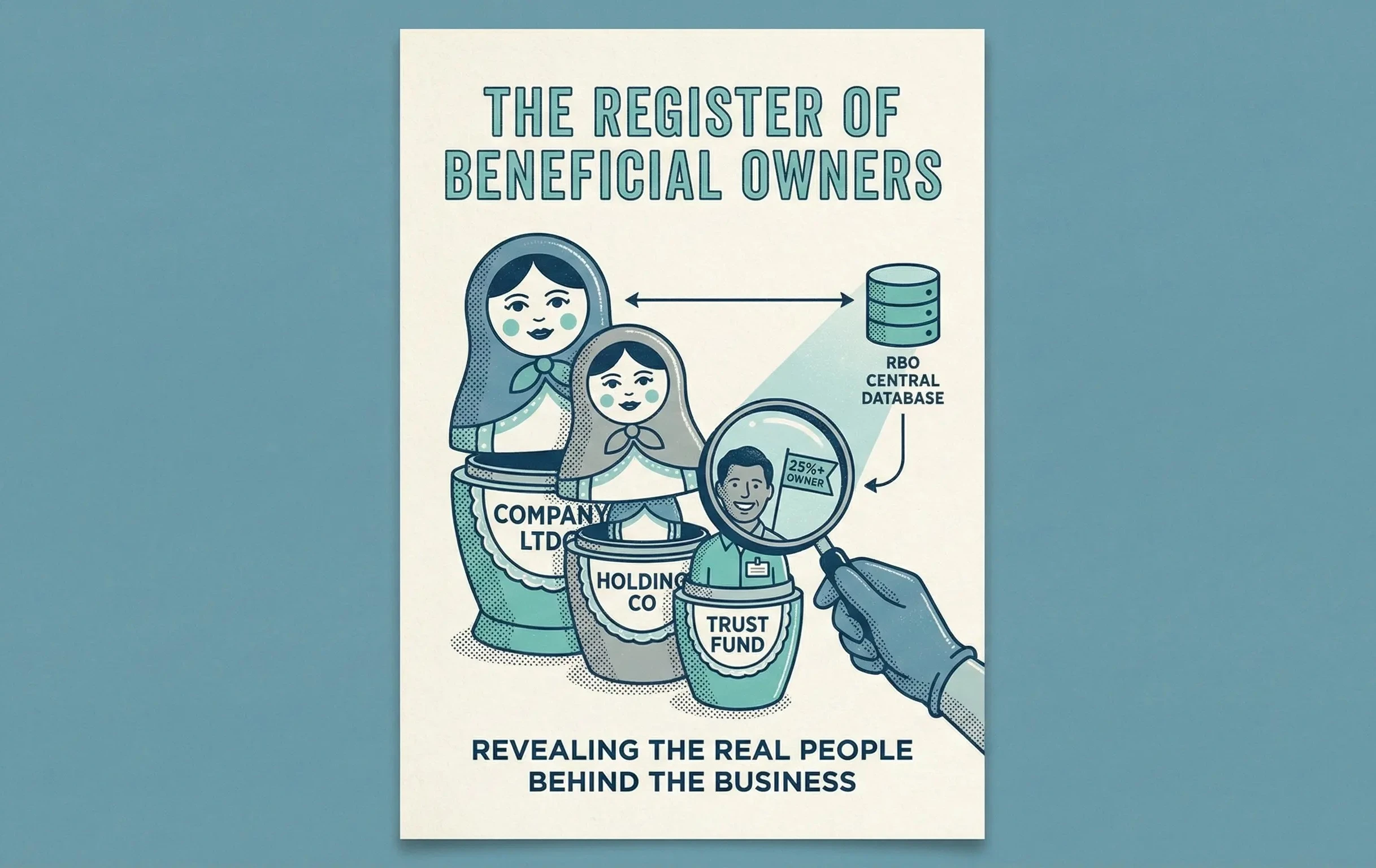
The Register of Beneficial Owners (RBO) is a central database identifying the natural persons who ultimately own or control Irish companies.
The RBO improves corporate transparency by making it clear to law enforcement, regulatory authorities, and the public who ultimately owns and controls Irish companies.
The register aims to combat money laundering and terrorist financing by preventing criminals from hiding behind corporate structures.
The RBO is a standalone register established under anti-money laundering legislation, not company law.
Who Is a Beneficial Owner?
A beneficial owner is:
- Any natural person who ultimately owns or controls a legal entity through direct or indirect ownership of at least 25% of shares, voting rights, or ownership interest
- Control includes direct shareholding where the person holds 25% or more shares
- Control includes indirect ownership through other companies or trusts, and exercising significant influence over company decisions
- Only natural persons can be beneficial owners - companies and trusts must be traced back to the actual people behind them
Which Companies Must File with the RBO?
All companies incorporated in Ireland must file, including private limited companies, public limited companies, designated activity companies, companies limited by guarantee, and private unlimited companies.
Industrial and provident societies also fall within the RBO requirements under SI 110/2019.
Branches are not entities incorporated in Ireland and therefore are not required to file beneficial ownership details.
Companies listed on regulated markets subject to EU disclosure requirements may be exempt, though their subsidiaries must still comply independently.
.webp)
What Information Must Be Filed?
Companies must file comprehensive details about each beneficial owner through the online RBO portal. Required information includes:
- Full name as it appears on official documents
- Date of birth including day, month, and year
- Nationality of the beneficial owner
- Residential address where they normally reside
- PPS number for identity verification
- Nature and extent of interest explaining the ownership or control
- Date interest acquired when they became a beneficial owner
This comprehensive data is then filed with the RBO to ensure regulatory compliance.
When Must You File with the RBO?
A newly incorporated entity has five months from incorporation to register its beneficial ownership with the RBO.
For companies incorporated before 22 June 2019, the initial deadline was 22 November 2019.
Businesses must record any changes to their beneficial ownership on the central register within 14 days.
This ongoing obligation means companies must monitor and update beneficial ownership information promptly whenever changes occur.
How Do You File with the RBO?
In order to file data with the RBO, a person must first register as a user on the RBO's online registration portal at www.rbo.gov.ie and be issued with a username and password.
The filing process involves:
- Register as a user on the RBO portal with your details
- Verify your identity using your company officer credentials
- Complete the beneficial owner details with accurate information
- Upload required documentation including verification forms if needed
- Submit the filing electronically through the portal
There is no fee for filing beneficial ownership information with the RBO.
Who Can File on Behalf of the Company?
The responsibility of fulfilling RBO obligations lies with the company's officers, the directors and the company secretary.
An officer or employee of the company can discharge the company's obligation by completing the registration process on the RBO's online portal.
Alternatively, companies can appoint a presenter such as an accountant or company formation agent to file on their behalf.
The company's officers remain ultimately responsible for ensuring accurate and timely filing even when using a presenter.
Who Can Access RBO Information?
The RBO operates a tiered access system depending on who is requesting information.
Unrestricted access to RBO data is provided to authorized officers of An Garda Síochána, the Financial Intelligence Unit, Revenue Commissioners, Criminal Assets Bureau, Central Bank of Ireland, and certain other regulatory authorities.
Tier two access is available to designated persons required to conduct customer due diligence, including financial institutions, accountants, auditors, tax advisers, and legal professionals.
Members of the public can access RBO data through an online portal and purchase an "RBO Report of Beneficial Owners/Controllers".
What Does the Public RBO Report Show?
Public RBO reports show limited information compared to what authorities can access. The public report includes:
- Forename and surname of beneficial owners
- Month and year of birth (not the full date)
- Nationality of the beneficial owner
- Country of residence (not the full address)
- Nature and extent of interest explaining the control
This strikes a balance between transparency and privacy by revealing ownership without exposing complete personal details.
What Happens If You Don't Comply?
Failure to comply with RBO requirements is a breach of statutory duties and a criminal offence which is subject to sanctions.
The 2019 regulations create the possibility of conviction on indictment and a €500,000 fine for certain breaches.
If any beneficial owner or presenter knowingly provides incorrect details, they will face prosecution.
Directors and company secretaries face personal liability for compliance failures under their statutory duties.
What If You File Incorrect Information?
If incorrect information is provided by mistake, the RBO will be unable to validate the beneficial owner and the submission will be rejected.
The RBO will contact the beneficial owner directly via written correspondence, but due to data protection legislation, the RBO cannot contact the presenter regarding the beneficial owner's details.
This validation process helps ensure accuracy but requires companies to work directly with beneficial owners to correct any errors.
Companies should verify all information carefully before their submission to avoid rejection and compliance delays.
How Do You Update Beneficial Ownership Information?
The 14-day update requirement applies whenever beneficial ownership changes occur in your company.
Common triggers requiring updates include:
- existing beneficial owners increasing their shareholding above 25%
- new investors acquiring 25% or more ownership or control
- beneficial owners reducing their interest below 25%
- and transfers between beneficial owners
Companies must monitor shareholding changes and ensure RBO filings remain current and accurate. The online portal allows companies to log in and update beneficial ownership information as changes occur.
Can Beneficial Owners Request Privacy?
The RBO's three-tier access system already provides some privacy protection by limiting public access to basic details only.
Beneficial owners concerned about personal safety can apply for exemptions from certain disclosure requirements in exceptional circumstances.
However, the general principle is transparency to combat financial crime, so privacy exemptions are granted restrictively.
Law enforcement and regulatory authorities always maintain full access regardless of any privacy restrictions granted to the public.
How Does RBO Affect Due Diligence?
The RBO significantly improves due diligence processes for businesses dealing with Irish companies.
Banks, investors, and suppliers can verify beneficial ownership before entering relationships, confirming that companies are not controlled by sanctioned individuals or entities, and satisfying their own anti-money laundering obligations.
The public reports provide ownership verification compared to traditional due diligence methods. This transparency benefits compliant businesses by making it easier to demonstrate legitimate ownership and control.

Stuart Connolly is a corporate barrister in Ireland and the UK since 2012.
He spent over a decade at Ireland's top law firms including Arthur Cox & William Fry.

.webp)
.webp)
.webp)


.webp)