This article is ideal for pre-launch or first-year founders agonizing over solo vs co-founder, seeking how to find or vet partners, or structuring teams to avoid early failures.
You will gain a practical framework for self-assessment, partner search, trial periods, and agreements, empowering confident decisions that align with skills, timeline, and goals.
Key Takeaways
The wrong co-founder destroys companies faster than going solo. Decide based on necessity and complementary value, not mythology.
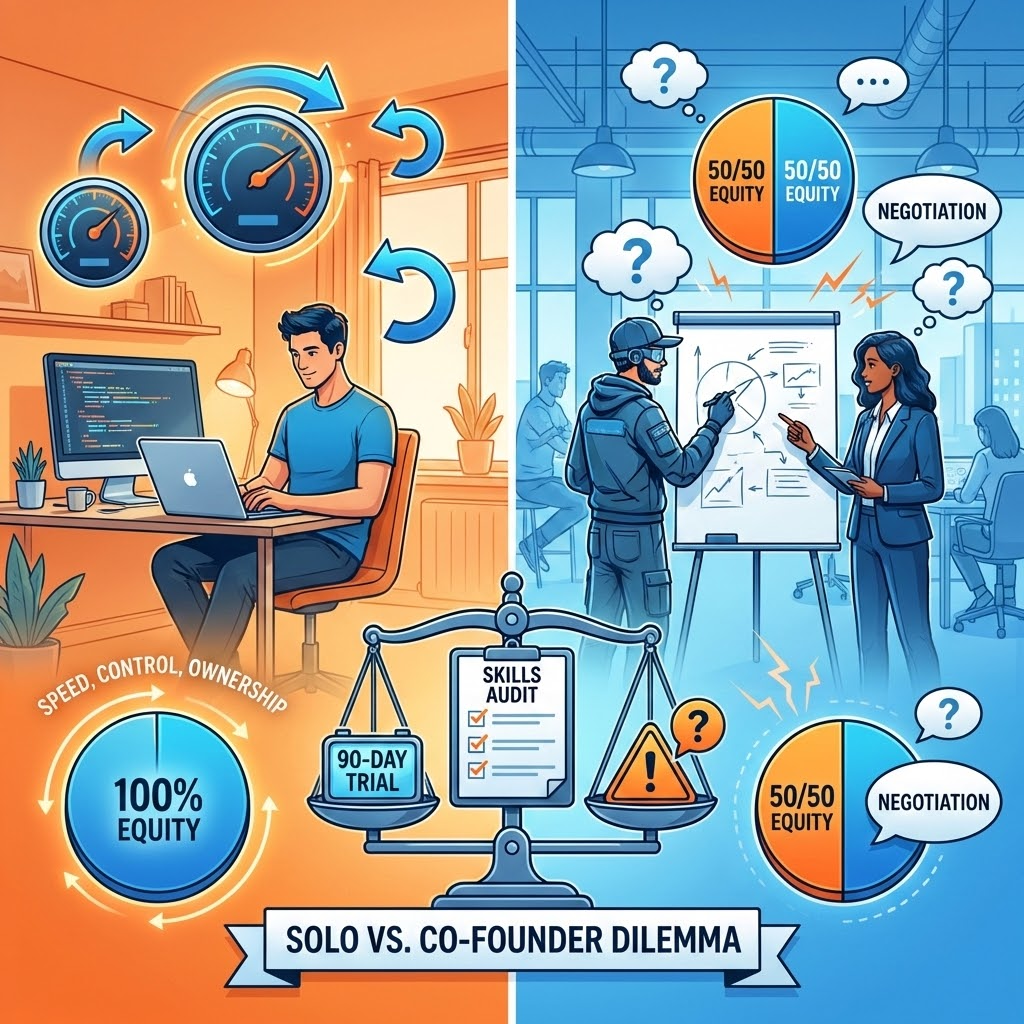
Go solo for speed if you can execute critical functions; hire later for gaps instead of permanent dilution.
Conduct a skills audit to identify gaps in product, sales, operations before seeking a co-founder.
Test partnerships with a 90-day trial focusing on execution, alignment, and stress response before equity.
Formalize with clear equity splits, roles, CEO tiebreaker, vesting, and hard conversations on exits and conflict.
Should I go solo or find a co-founder for my startup?
Go solo if you can build the MVP yourself, your industry rewards speed, you have clear vision and conviction, or you're in exploration phase. A co-founder is essential if you can't build the core product, the domain requires dual expertise, or you're unbalanced in critical functions like sales or product.
When is a co-founder not optional?
Warning signs include inability to build core product (e.g., non-technical founder for software), domains needing dual expertise like healthcare tech or fintech, or fundamental imbalances where you're visionary without execution or vice versa. Use the $10K MRR litmus test.
How do I find the right co-founder?
Use concentric circles: first people you've worked with, then friends of friends, domain communities, accelerators. Define profile via skills audit. Have vision, work style, hard stuff conversations. Watch for red flags like no execution track record or evasive past.
What is the 90-day trial for co-founders?
Work together 90 days before equity commitment to test execution, communication, work ethic, values, stress response. Frame honestly, set deliverables, use deferred equity. Checkpoint: trust, desire to continue, material improvement. Red flag if they resist trial.
How should I split equity with a co-founder?
Default 50/50 only if equal contributors in time, risk, irreplaceability. Otherwise, 60-70% for founding CEO/idea originator, 30-40% for later joiner. Use 4-year vesting with 1-year cliff. Ensure it feels fair to avoid resentment.