Startup founders in Ireland raising seed or Series A rounds encountering pro rata rights in term sheets, who need to model implications and negotiate without friction in future fundraises.
Investors and legal advisors handling Irish venture deals will gain insights into documentation, calculations, interactions with anti-dilution and pre-emption, plus founder checklist for balanced terms.
If you're raising a seed or Series A round in Ireland, you will almost certainly see "pro rata rights" in the term sheet. Investors treat them as standard. Founders often sign them without fully modelling what they mean for the next round. Pro rata rights in Ireland give investors, and other shareholders, the option to keep their percentage ownership by buying into future rounds, and they can quietly shape every follow-on decision you make. This article explains how pro rata rights work under Irish deals, where they live in your documents, how they interact with pre-emption and anti-dilution terms, and the carve-outs worth negotiating before you sign.
What are pro rata rights in plain English?
A pro rata right is a contractual option that lets an existing shareholder buy enough shares in a future funding round to keep their ownership percentage unchanged. If an shareholder holds 10% of your company before a new round, a pro rata right lets them purchase up to 10% of the new shares being issued in that round at the same price as new investors.
Investors ask for pro rata because it protects their economic and strategic position. Early backers who have taken the most risk want the right (not the obligation) to keep backing a winner. Without pro rata, their stake gets diluted every time you raise.
"Pro rata" is sometimes used interchangeably with "pre-emption" in founder conversations, but the two are not the same thing. Pre-emption rights under the Companies Act 2014 are a statutory right for existing shareholders to participate in new share issues. Pro rata rights are a contractual layer that sits on top, usually defined more narrowly and granted only to specific investors named in the shareholders' agreement .
The key difference is: pre-emption is a statutory default available to shareholders generally; pro rata is a negotiated contractual right, usually limited to major investors.
Where pro rata rights are documented in Irish deals
Pro rata rights typically appear in three places in a standard Irish venture deal.
Term sheet. The early mention, usually one or two lines confirming that investors will have the right to participate in future rounds to maintain ownership. At this stage the wording is often loose and non-binding.Shareholders' agreement (SHA). The binding version. The SHA is where the right is defined in detail: who holds it, how it is calculated, when it is triggered, and what happens if an investor does not exercise it.Side letters. Individual investors sometimes negotiate bespoke pro rata arrangements outside the SHA, especially if they want "super pro rata" (the right to buy more than their percentage) or special carve-outs.
The SHA is the document that actually matters. If the term sheet says one thing and the SHA says another, the SHA wins. For more on structuring the underlying documents, read our Shareholder Agreement guide.
How pro rata is calculated
The calculation sounds simple, but it hides several decisions that materially change the outcome.
Start with the investor's current ownership percentage. That percentage is applied to the new shares being issued, giving the investor the right to buy that portion of the new issue at the round's price per share.
The pivotal questions are:
Fully diluted vs. issued share capital. Fully diluted includes the option pool , convertibles, and warrants. Issued share capital counts only shares actually allotted. Fully diluted almost always produces a smaller percentage for existing investors, which is why founders generally prefer it as the base.What counts as "the round". Does the new investor's allocation include a pre-round option pool top-up? A concurrent SAFE conversion? If yes, existing investors get pro rata on a larger pool of shares, which reduces the allocation available to new money.Treatment of convertibles. When a SAFE or convertible loan note converts at the round, the converting shares are typically excluded from pro rata calculations to avoid double-counting.
A simplified example: an investor owns 10% on a fully diluted basis. The company raises €2m at an €8m pre-money valuation, issuing €2m of new shares. The investor's pro rata entitlement is 10% of the new issue, so €200,000 worth of shares at the round price. Cap table modelling matters a lot here, and our Cap Table Management guide covers how to keep the numbers clean as rounds stack.
How pro rata affects future fundraising dynamics
Pro rata rights look harmless on paper, but they can create real friction in later rounds.
The first issue is allocation. A new lead investor often wants a specific ownership target, say 15% or 20%. If your existing investors collectively exercise pro rata rights over 30% of the round, the new lead may find their allocation squeezed below what they need to lead. That can push you into enlarging the round (more dilution ) or into awkward conversations with legacy backers asking them to stand down.
The second issue is signalling. If a prominent existing investor declines to take their pro rata, new investors often read it as a negative signal, whether fair or not. Founders end up managing investor expectations carefully each round to avoid that outcome.
The third issue is administrative burden. Every round requires formal notice to pro rata holders, a window for them to respond, and documentation of their decision. A crowded cap table of pro rata holders can add weeks to a round's timeline.
Common carve-outs and founder-friendly limitations
Pro rata is rarely an all-or-nothing clause. Most Irish SHAs include limitations that founders should push for:
Major investor threshold. Pro rata is granted only to investors holding above a minimum stake (often 3% to 5%) or who have invested above a minimum cheque size. This keeps the cap table manageable.Excluded issuances. Shares issued under the employee option pool, to strategic partners, or as part of an acquisition are usually carved out of pro rata calculations.Time-limited pro rata. The right expires after a set period or after a specific event such as an IPO or Series C. This stops pro rata following the company forever.Use-it-or-lose-it. If an investor declines to participate in one round, their pro rata right lapses permanently. This is a strong founder-friendly provision and worth pushing for.
These carve-outs are standard in Irish venture deals, but they are not automatic. If they are not written into the SHA, they are not in the deal.
Interaction with other rights
Pro rata sits alongside a handful of related investor protections, and the interactions matter.
Pre-emption rights on issue. The statutory default under the Companies Act 2014. Pro rata rights generally override or supplement pre-emption, and the SHA should make the relationship explicit. See our Pre-emption Rights guide for the statutory position.Anti-dilution protection. Economic protection against down rounds, usually weighted average or full ratchet. Anti-dilution adjusts the conversion price of prior shares, while pro rata gives the right to buy more. Different mechanisms, often held by the same investors. Our Down Rounds article explains how these interact in a stressed round.Information and protective rights. Investors cannot make an informed pro rata decision without timely financials and a clean notice of the round. The SHA's info rights clause should line up with pro rata timelines.
Thinking about these rights as a package rather than in isolation is the difference between a tight SHA and a leaky one.
Founder checklist before agreeing pro rata
Before you sign pro rata terms, work through these steps:
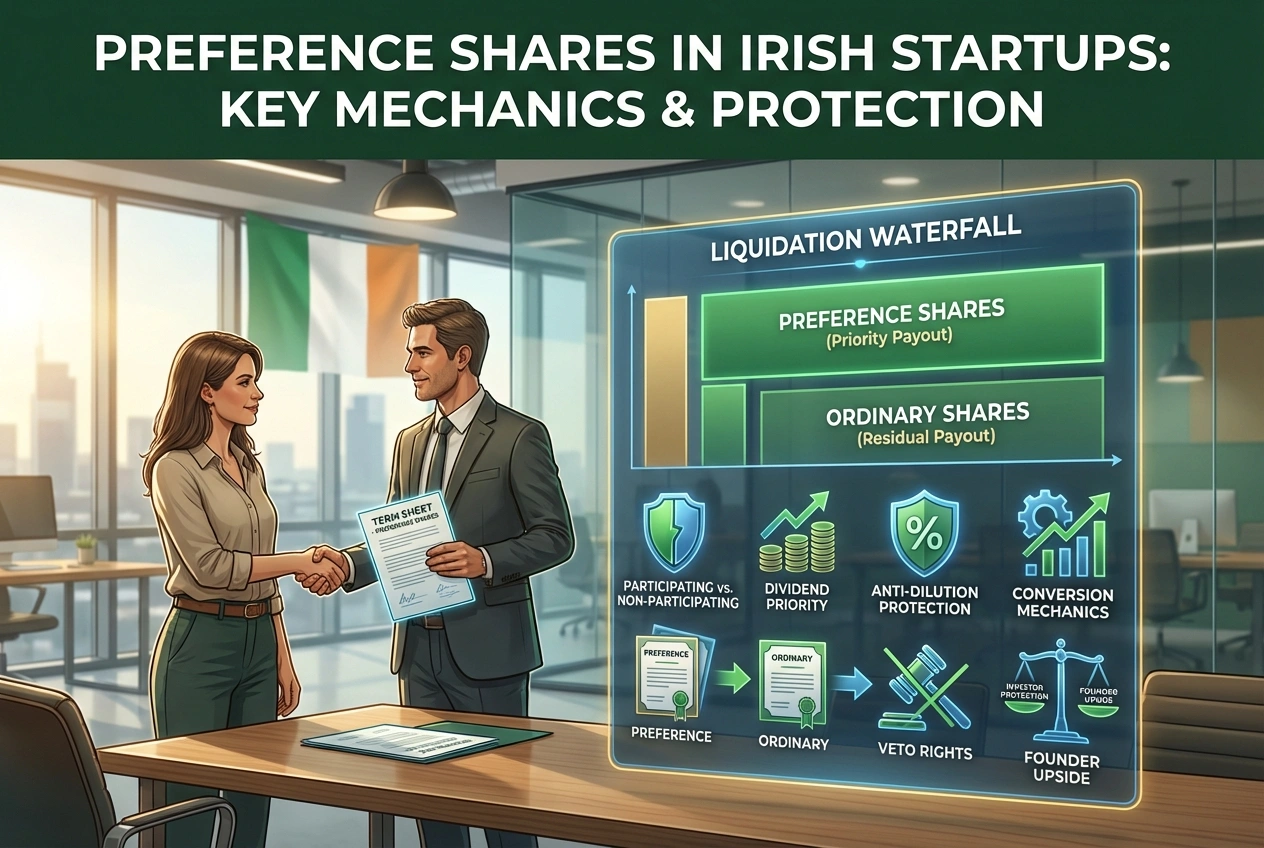
Model the next round. Stress-test what happens if every pro rata holder participates fully. Does the new lead still get their target allocation?Align pro rata with strategy. If you plan to run a competitive Series A, you may want stricter carve-outs. If you expect friendly follow-on, broader pro rata is less risky.Document carve-outs clearly. Every carve-out (option pool, strategic, convertibles, time limits) must be in the SHA, not implied.Avoid side-letter sprawl. One investor with super pro rata is manageable. Five is not. Keep bespoke terms to a minimum and reflect them in the SHA where you can.Review alongside the wider deal. Pro rata interacts with vesting, board composition , and liquidation preferences. Read our Term Sheet guide to see how these fit together.
As of April 2026, Irish venture deals continue to treat pro rata as standard for major investors, but the scope and carve-outs are increasingly founder-friendly in seed rounds. That is a position worth using.
Author's tip: Ask for "use-it-or-lose-it" pro rata as the default. It keeps your cap table clean and rewards investors who actually follow on.
Where this leaves you
Pro rata rights are not inherently bad for founders. They reward loyal investors, can make your next round faster to close, and keep strong backers on the cap table. The risk comes from agreeing to them without modelling the next round or without the carve-outs that preserve your flexibility.
The single most important step is to read the SHA wording carefully, compare it to the term sheet, and confirm that every carve-out you agreed verbally is in the signed document. If you're preparing a seed or Series A round, Open Forest can review your SHA and flag pro rata language that will cause problems two rounds from now.





.webp)