This article is for international business owners and executives deciding how to establish operations in Ireland.
If you're weighing whether to set up an Irish subsidiary or register a branch—and wondering which structure protects your business while minimizing tax complexity—this guide covers the liability differences, tax implications, and when each option makes sense for your expansion.
Key Takeaways
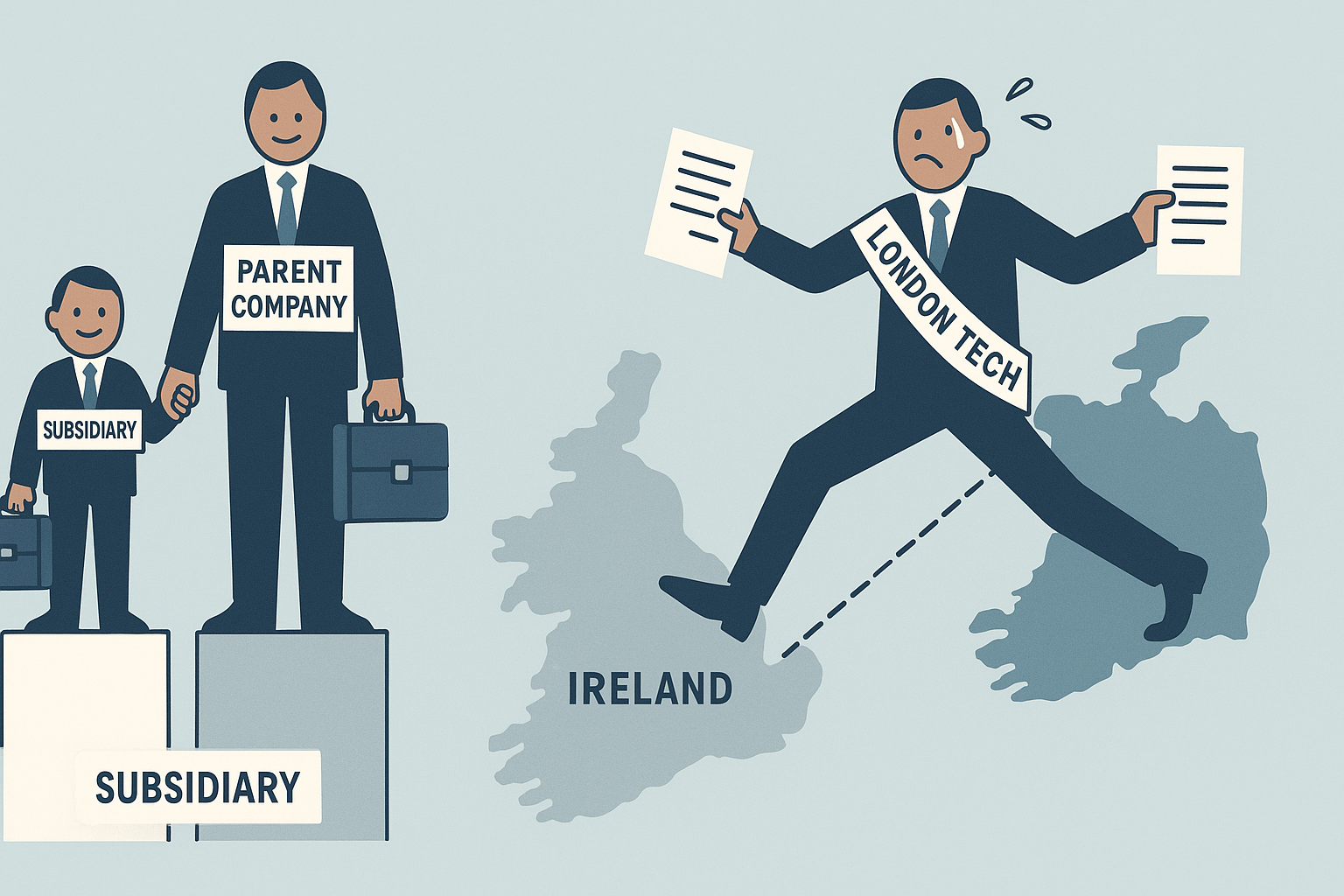
A subsidiary creates liability protection by limiting parent company exposure to its investment, while branches expose the entire foreign company to Irish liabilities.
Irish subsidiaries pay 12.5% corporation tax on trading income with clear profit separation, while branches face complex dual-jurisdiction taxation.
Subsidiaries offer operational flexibility for local partnerships, independent fundraising, and easier exit strategies compared to constrained branch structures.
Most international companies should choose subsidiaries for significant Irish operations unless testing the market short-term or facing specific regulatory requirements.
Converting between branch and subsidiary structures later is expensive and time-consuming, so choose the correct structure from the start.
What's the main difference between a subsidiary and a branch in Ireland?
A subsidiary is a completely separate Irish company that you own, with its own legal identity and limited liability protection. A branch is simply your existing foreign company operating in Ireland—it's the same legal entity, just in a different location, which means no liability protection for your parent company.
If my Irish subsidiary gets into financial trouble, can creditors go after my parent company?
No, creditors can only pursue the subsidiary's assets, not your parent company's assets. Your parent company's liability is limited to whatever you invested in the subsidiary (the share capital), which is the key advantage of the subsidiary structure.
How does taxation work differently for subsidiaries versus branches?
An Irish subsidiary pays Irish corporation tax at 12.5% on its trading income and files separate Irish tax returns, giving you control over when to distribute profits to the parent. A branch's income is attributed directly to your foreign company, creating complexity with potential taxation in both Ireland and your home country, plus transfer pricing issues.
How long does it take to set up an Irish subsidiary and what does it cost?
Setting up an Irish subsidiary typically takes 5-10 working days through the standard incorporation process. Costs start from €99 with Open Forest, plus ongoing compliance costs, which is similar to branch setup costs initially.
When should I choose a branch instead of a subsidiary?
Branches make sense mainly for short-term market testing, very limited operations, or specific regulatory requirements in certain industries. However, even in these situations, many companies still choose subsidiaries for the liability protection and operational flexibility they provide.
Can I convert my branch to a subsidiary later if my business grows?
Yes, but it's complex and expensive—you'll need to incorporate a new Irish subsidiary, transfer all branch assets and contracts, close the branch registration, and handle careful legal and tax planning. It's better to choose the right structure from the start to avoid this hassle.
Is it harder to open an Irish bank account for a branch than a subsidiary?
Yes, branch banking is more complex because banks may require parent company documentation and guarantees, and some banks are hesitant about branch accounts. Subsidiaries can open Irish business bank accounts in their own name through the standard process for Irish companies.
What compliance obligations does an Irish subsidiary have?
Irish subsidiaries must file annual returns to the CRO, prepare and file financial statements, submit Irish corporation tax returns, maintain statutory registers, appoint a company secretary, and hold annual general meetings (unless exempt from audit requirements). These are standard requirements for any Irish company with clear, well-established processes.




.webp)