This article is for Irish company directors and founders who need to understand whether their company is "trading" and what that means for their tax obligations.If you're confused about when to register for corporation tax, whether your business activities count as trading, or what happens if you get the timing wrong, this guide covers the legal definition of trading, when your tax registration deadline actually starts, and the key differences between trading and non-trading companies.
Key Takeaways
• Trading companies must register for corporation tax within one month of their first sale or revenue, not from incorporation date.
• Trading income is taxed at 12.5% while passive investment income faces 25% corporation tax in Ireland.
• You're trading when you receive your first customer payment, not when you incorporate or buy equipment.
• Late tax registration penalties range from €500 to €3,000, plus interest on any back-dated tax owed.
• Holding companies are non-trading but still require annual returns, financial statements, and corporation tax registration.

What Does "Trading" Actually Mean?
Here's the frustrating bit: Irish company law doesn't give you a simple yes/no test for whether your company is trading.
The Companies Act and Revenue both use the term "trading" constantly, but neither provides a straightforward definition. Instead, you have to look at what your company actually does and apply some general principles.
Trading generally means:
- Buying or selling goods or services
- Providing professional services for payment
- Generating revenue from business activities
- Carrying on commercial operations with a profit motive
Think of trading as active commercial activity. If your company is engaged in business operations to make money, you're almost certainly trading.
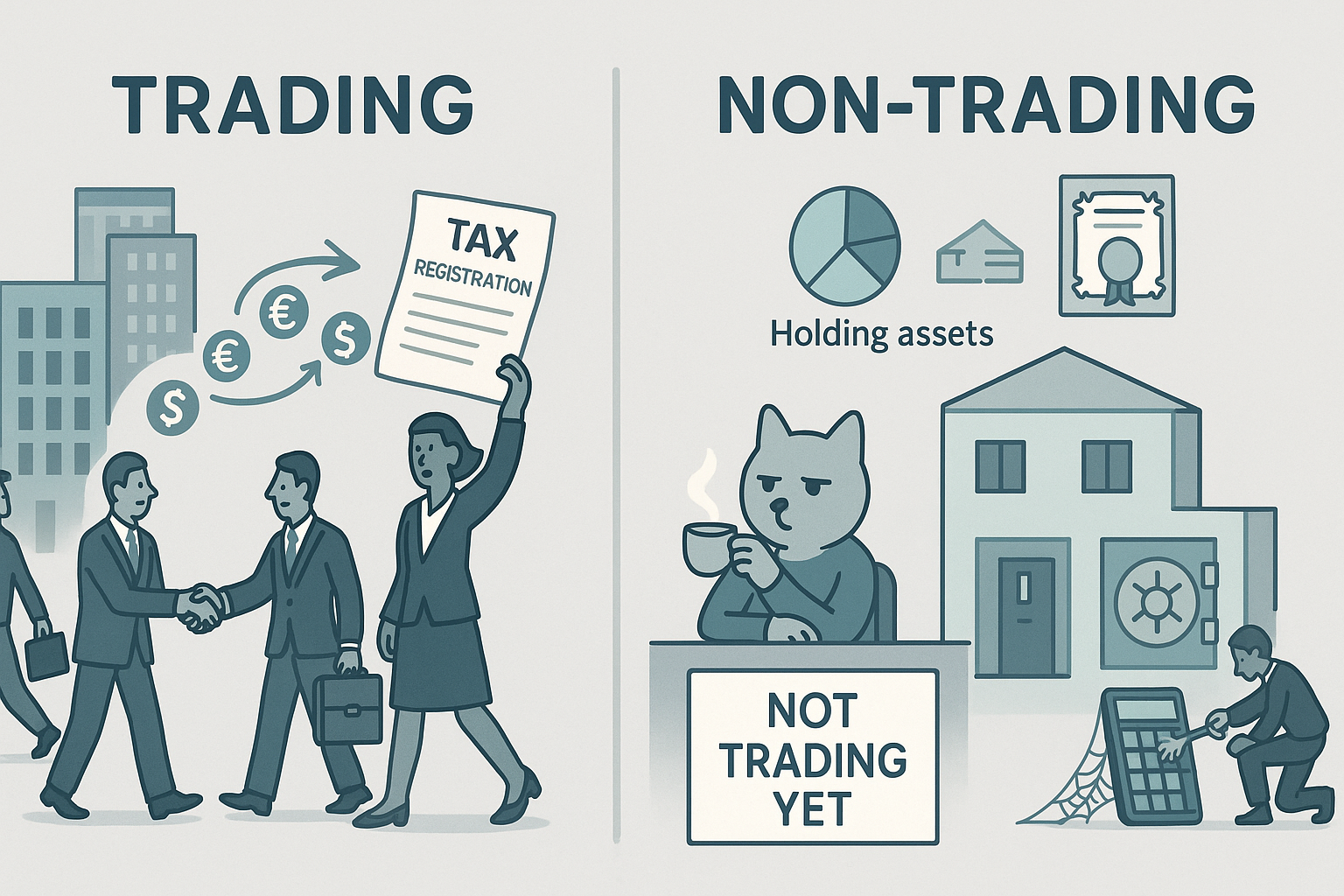
What Makes a Company Non-Trading?
Non-trading companies exist and are perfectly legitimate, but they're not conducting active business operations.
Common examples of non-trading companies:
- Holding Companies - These exist solely to own shares in other companies. They don't sell products, provide services, or generate trading revenue. Their only income typically comes from dividends or capital gains on investments.
- Dormant Companies - These have no significant accounting transactions during the financial year beyond the specifically permitted ones (CRO fees, registered office costs, share capital subscriptions).
- Asset-Holding Companies - Some companies exist just to own intellectual property, property, or other assets without actively trading them.
- Special Purpose Vehicles - These might be set up for a specific transaction or purpose but don't engage in ongoing trading activities.
The key distinction is that non-trading companies exist for ownership, holding, or administrative purposes rather than active commercial operations.
Why Does This Distinction Matter?
The trading vs non-trading distinction affects several important compliance obligations and tax treatments.
Tax Registration Timing
This is the big one that catches people out.
Trading companies must register for corporation tax within one month of starting to trade. Not one month from incorporation - one month from when trading actually begins.
Miss this deadline and you're looking at penalties, even if you don't owe any tax yet.
Non-trading companies should still register for tax, but the urgency is different. If you're genuinely non-trading, Revenue won't penalise you for delayed registration in the same way - though it's still good practice to register.
Corporation Tax Rate
Ireland's famous 12.5% corporation tax rate applies specifically to trading income.
Non-trading companies face different rates:
- Passive income (like rental income or investment income) is taxed at 25%
- Capital gains are taxed at 12.5% but under different rules than trading profits
If your company has both trading and non-trading income, you'll need to separate them in your tax calculations.
Accounting and Reporting
Trading companies need proper accounting systems to track:
- Sales and revenue
- Cost of goods sold
- Operating expenses
- Trading profit or loss
Non-trading companies typically have much simpler accounts - they might just show shareholdings, dividends received, and basic administrative costs.
When Revenue Starts Caring
Revenue becomes immediately interested in trading companies because that's where most corporation tax comes from.
For non-trading companies, Revenue's interest is lower unless you're:
- Receiving significant investment income
- Making capital gains
- Part of a group structure, avoiding tax
When Does Trading Actually Start?
This is where it gets tricky, and it's the question that causes most confusion.
Trading doesn't begin when you:
- Register your company with the CRO
- Open a business bank account
- Design your logo or build your website
- Print business cards
Trading typically begins when you:
- Make your first sale to a customer
- Provide your first paid service
- Start receiving revenue from business operations
- Begin fulfilling contracts that generate income
The grey areas:
What about when you're setting up but not quite trading yet? Here's how to think about common scenarios:
- Buying equipment or stock - Preparing to trade, but not yet trading. However, you're getting close.
- Paying for business setup costs - Still not trading. These are pre-trading expenses that you can often claim later.
- Receiving your first payment - Now you're trading. Even if it's just a deposit or your first invoice being paid.
- Signing your first contract - Probably trading, especially if work has commenced under that contract.
The safest approach? If you're genuinely unsure, register for tax. There's no penalty for registering "too early," but there are penalties for registering late.
Holding Companies: A Special Case
Holding companies deserve specific attention because they're the most common type of non-trading company.
A holding company exists to own shares in subsidiary companies. It doesn't trade itself - the subsidiaries do the actual business operations.
Why use a holding company structure?
- Separates ownership from operations
- Protects assets if one subsidiary faces liability
- Makes it easier to sell individual subsidiaries
- Can provide tax advantages for group structures
- Simplifies investment rounds for startups
Key point: A holding company is non-trading, but it still has obligations:
- Must file annual returns
- Must prepare financial statements
- May need to file consolidated accounts if it's a group
- Still needs corporation tax registration (though returns may show minimal activity)
Holding companies often hold investments and receive dividend income. This is investment income, not trading income, so it's taxed differently.
Common Misconceptions
"I haven't made any profit yet, so I'm not trading."
Wrong. Trading is about activity, not profitability. Plenty of companies trade at a loss for years. If you're selling goods or services, you're trading - whether you're profitable or not.
"I'm just testing the market, so I don't need to register."
If you're receiving payments from customers, even small amounts, you're trading. Market testing that involves actual transactions counts as trading.
"My company is dormant, so I don't need to worry about trading status."
Dormant is a specific status with strict rules. If you're doing anything beyond the six permitted transactions, you're not dormant - and you might be trading.
"I can decide whether my company is trading or not."
You can't just declare your status. Revenue and the courts will look at your actual activities to determine if you're trading. What you call yourself doesn't matter - what you actually do is what counts.
What Happens If You Get It Wrong?
Getting your trading status wrong - especially starting to trade without registering for tax - creates problems:
- Revenue penalties for late tax registration can range from €500 to €3,000 depending on circumstances and how late you are.
- Back-dated obligations mean you might need to file returns retroactively, and if you owe tax, you'll face interest charges going back to when you should have paid.
- Compliance complications arise when your company records don't match your tax status. Fixing these issues costs time and money with accountants.
- Audit risk increases because Revenue flags companies with registration timing issues for closer scrutiny.
The worst part? These problems are completely avoidable with proper planning and timely registration.
Practical Guidance: What Should You Do?
If you're definitely trading:
- Register for corporation tax within one month of your first trading transaction
- Set up proper accounting systems from day one
- Keep clear records of when trading commenced
- Work with an accountant to ensure proper tax compliance
If you're not sure:
- Document what transactions you're actually making
- Consult with an accountant before your first revenue-generating activity
- When in doubt, register - there's no penalty for early registration
- Keep evidence of your business activities to justify your position if queried
If you're definitely non-trading:
- Make sure you genuinely meet the definition (no revenue-generating activities)
- Still register for tax, even if you're filing "nil" returns
- Understand that your status can change - if you start trading, register immediately
- Keep your compliance obligations current (annual returns, financial statements)
How Can Open Forest Help?
Open Forest works with both trading and non-trading companies to ensure proper compliance from day one.
We'll help you:
- Understand whether your planned activities constitute trading
- Register for tax at the right time
- Set up appropriate accounting systems for your company type
- Track compliance obligations specific to your trading status
- Connect you with our partner accountants who guarantee the cheapest prices on the market for tax compliance
Our platform tracks all your obligations automatically, so you'll never miss a tax registration deadline or filing requirement - regardless of whether you're trading or not.
Check out our incorporation packages here, all designed to set you up correctly from the start.

Stuart Connolly is a corporate barrister in Ireland and the UK since 2012.
He spent over a decade at Ireland's top law firms including Arthur Cox & William Fry.