Event organisers running conferences, workshops, trade fairs or streamed events in Ireland need this guidance to handle VAT compliance correctly.
Overseas businesses and first-time organisers will learn the exact registration steps, rate selection, and platform considerations required before selling tickets.
Key Takeaways
- Physical event admission is always taxed where the event takes place under Irish VAT rules.
- Virtual event rules changed in 2025 for B2C sales, now taxed at the customer's location.
- Non-established organisers must register for Irish VAT with no threshold for physical events.
- Platform terms determine whether organiser or platform accounts for VAT to attendees.
- Document your reasoning for hybrid or mixed events to support VAT rate decisions.

If you run a conference in Dublin, sell tickets to a workshop in Galway, or invite delegates to a trade fair in Cork, VAT will follow the venue. Charges for physical admission to an event in Ireland fall under Irish VAT, no matter where the attendee or organiser is based. That rule is simple on paper but easy to misread once virtual streaming, overseas speakers, and third-party ticket platforms enter the picture.
This guide walks through what Revenue actually expects, where the 2025 rules changed for virtual events, and the checks every event organiser should run before they print tickets.
Why event VAT is different
Most B2B services follow the customer's location. Event admission does not. Article 53 of the EU VAT Directive carves out admission to physical events as a special case, taxed where the event physically takes place. Ireland mirrors that rule. So a French SaaS company selling tickets to a Dublin tech summit charges Irish VAT, even if every attendee is German.
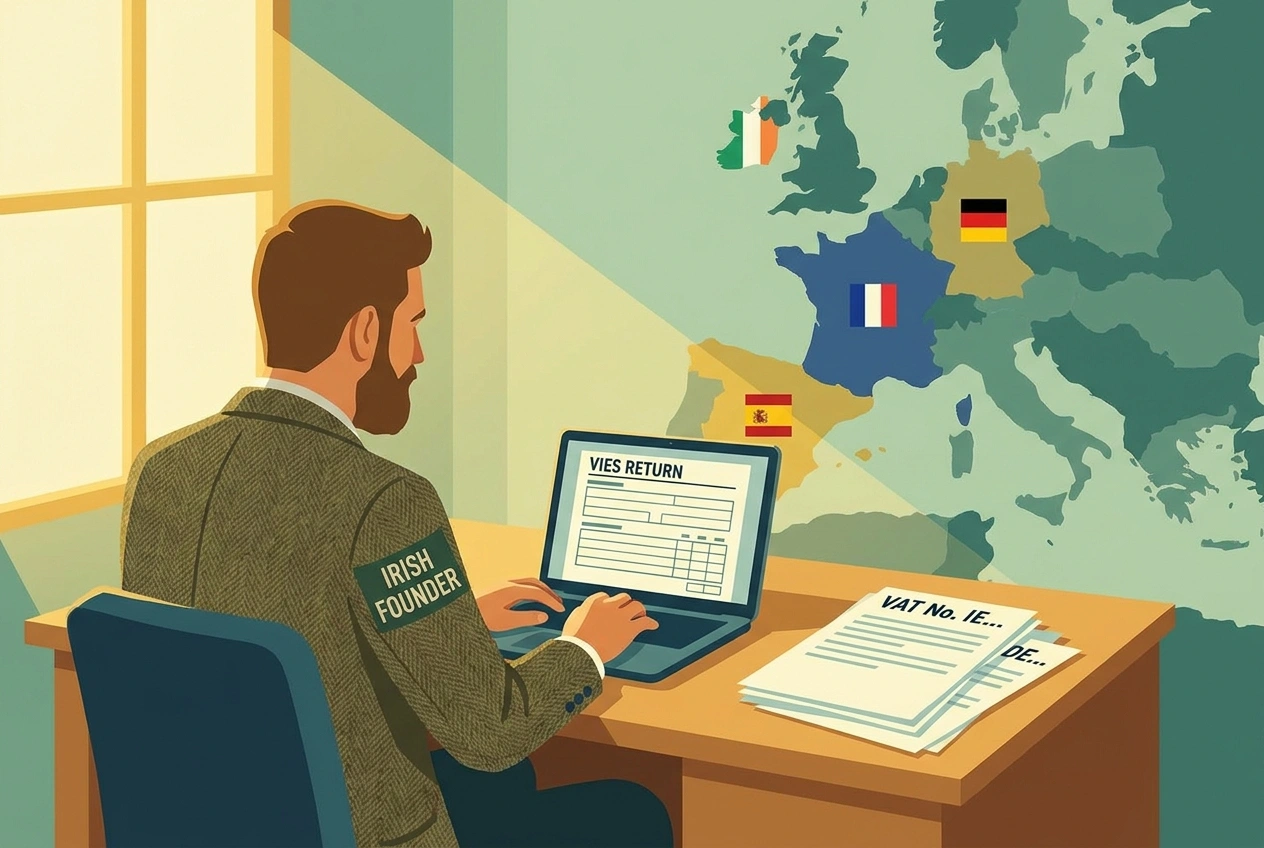
If you have never had to register here before, start with our VAT essentials for new Irish companies before diving into the event-specific layer.
Place of supply for admission
Revenue's updated guidance, published in July 2025, sets out four buckets you should think in:
- Physical event, B2B or B2C admission. Always taxed where the event happens. Dublin conference, Irish VAT, end of story.
- Ancillary services tied to admission (cloakrooms, programmes, paid Wi-Fi sold with the ticket). Same place of supply as the event itself.
- Virtual or streamed event sold to a business (B2B). The general B2B rule applies. The customer self-accounts under reverse charge in their own country.
- Virtual or streamed event sold to a consumer (B2C). From 1 January 2025, taxed where the customer is. Before that date, organisers charged VAT in their own country.
For hybrid events, meaning a live audience plus a paying stream, you may end up with two parallel VAT treatments on one invoice line. Split your ticket types early to make that workable.
Applicable Irish VAT rates
Ireland runs four Value Added Tax rates, and the one that applies to your ticket depends on what the event actually is:
- 23% standard. Business conferences, trade fairs, corporate workshops, networking events, steamed virtual events and pre-recorded events.
- 13.5% reduced. Tickets to the cinema, cultural events, theatrical and musical events where food or drink is available for consumption, concerts, and museum admissions.
- VAT Exempt. Circuses, theatrical and musical events where food or drink is available for consumption, sporting events, and certain qualifying educational events run by recognised providers.
If your event is a hybrid of culture and conference, for example a paid panel inside a music festival, Revenue will look at the dominant character of the supply. Document your reasoning in writing. If audited, that note becomes your defence.
Registration for overseas organisers
Non-established traders selling tickets to an Irish event do not get a registration threshold. The €42,500 services threshold applies only to businesses established here. If a US speaker bureau runs a one-day summit in Dublin and sells 200 tickets, it must register for Irish VAT registration before the first ticket is invoiced.
You have two paths:
- Direct Irish VAT registration. File a TR1 or TR2 with Revenue, get an Irish VAT number, charge 23%, file VAT3 returns bi-monthly. It is important to note, that it may take Revenue a number of weeks to accept the vat registration so submit the registrations well in advance of any event.
- One Stop Shop ("OSS") for streamed events to EU consumers only. If you sell streamed access to consumers across multiple EU states, the One Stop Shop lets you declare all EU consumer VAT through a single quarterly return.
OSS does not cover physical event admission. If your event takes place in person, you need a real Irish registration. If you are unsure whether your activity even counts as Irish trading, our guide on trading vs non-trading companies explains the threshold for tax presence.
Selling tickets via third parties
Platforms like Eventbrite, Ticketmaster, and Universe complicate the picture. The key question is whether the platform acts as agent or principal.
- Agent (disclosed). The organiser is the supplier. The organiser issues the vat compliant invoice, accounts for the full ticket price, and treats the platform fee as an input cost.
- Principal (undisclosed or deemed supplier). The platform sells to the attendee and pays the organiser a net amount. The platform handles VAT to the attendee. The organiser invoices the platform B2B.
Read the platform's terms before you set up the listing. Most major platforms publish a country-by-country VAT note, but Ireland is rarely covered in detail, so ask in writing if it is unclear.
Special cases worth knowing
- Free events. No VAT, but you cannot reclaim input VAT on directly attributable costs.
- Sponsorship income. Treated as a standard 23% B2B service, not as admission. Place of supply follows the general B2B rule.
- Conference accommodation. Attendees that are VAT registered and incur the expense as part of their business can reclaim VAT on qualifying conference accommodation through their own VAT3. The hotel still charges Irish VAT at booking.
- Mixed bundles. A €500 ticket that includes a €120 dinner needs an apportionment. Revenue's preference is fair commercial value, not a flat split.
Compliance checklist
Before you sell the first ticket:
- [ ] Confirm whether the event is physical, virtual, or hybrid
- [ ] Apply the correct VAT rate per ticket type
- [ ] Register for Irish VAT if you are non-established
- [ ] Decide on OSS for any EU B2C streamed revenue
- [ ] Document agent vs principal status with the ticket platform
- [ ] Issue VAT-compliant invoices in euro
- [ ] Calendar bi-monthly VAT3 deadlines and the Annual Return of Trading Details
- [ ] Keep ticketing and company records for six years (see our document retention guide)
- [ ] Track your Companies Registration Office CRO obligations alongside Revenue, including your annual return filing deadline
- [ ] Track your CRO obligations alongside Revenue, including your annual return filing deadline
Where this leaves you
Event VAT looks intimidating because the rules sit across three places: the EU Directive, Revenue's tax and duty manual, and the platform's terms. The practical decisions are limited, though. Get the place of supply right, pick the correct rate, register if you are not established, and keep your ticket data clean.
If you are organising your first Irish event and need an Irish VAT number plus the first few VAT3 returns handled, Open Forest can register your company and file on your behalf so you can focus on the event itself.

Paul Burke is a qualified ACA and CTA tax accountant in Ireland.He trained at Forvis Mazars in Galway, gaining experience in various tax heads including Income Tax, Corporation Tax, VAT, Payroll and Tax Advisory.He is now a Tax Consultant in a local tax firm.