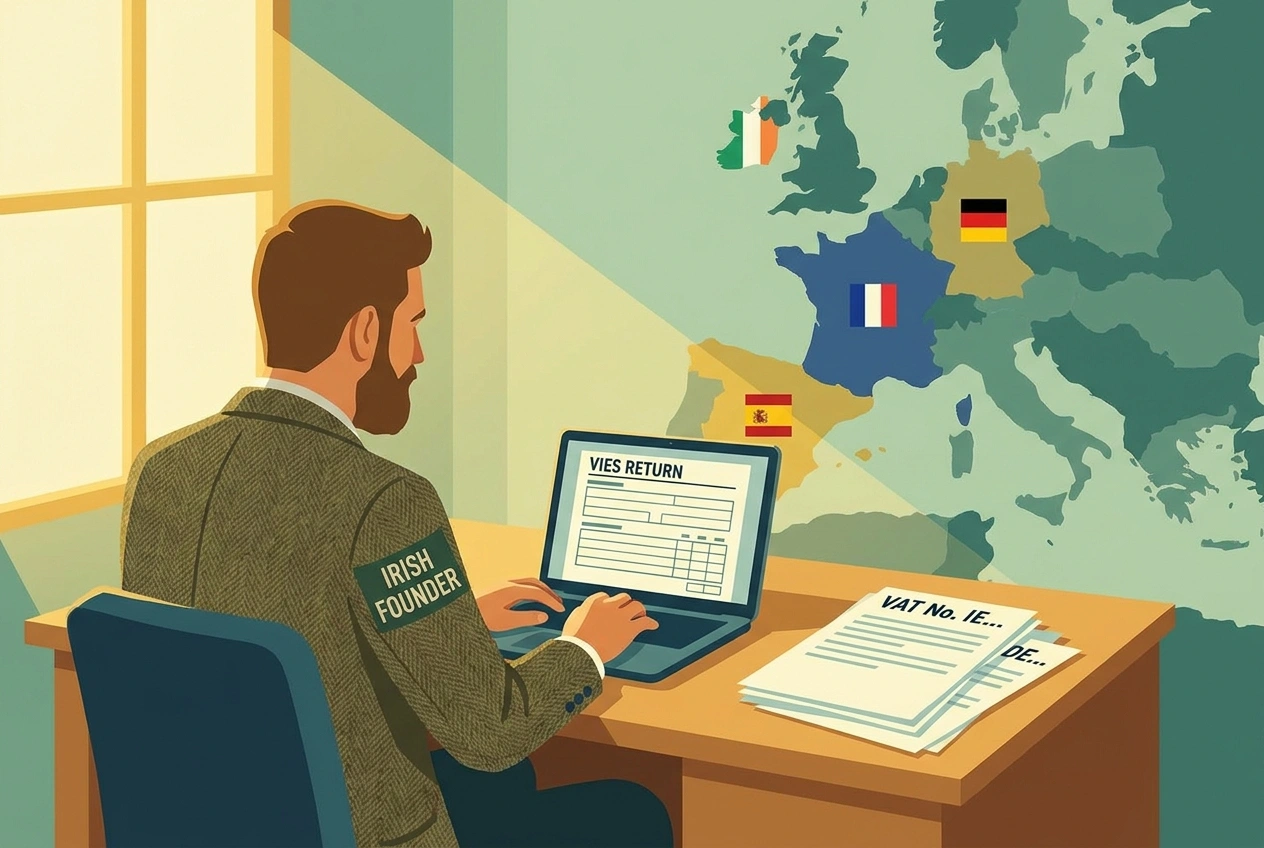
This article is for Irish VAT‑registered businesses that sell goods or services to VAT‑registered customers in other EU countries, as well as their accountants, finance managers, and tax compliance officers who handle intra‑EU reporting.
After reading, you will understand what VIES is, when you must file a VIES statement, the filing frequency and thresholds, how to complete and submit a return, and how to avoid common mistakes and penalties.
Key Takeaways
- Irish businesses must file a VIES return for any zero‑rated intra‑EU supply, and even a period with no qualifying sales requires a Nil return.
- Filing frequency is monthly unless quarterly thresholds are met – goods exceed €50,000 in the current or previous four quarters, otherwise quarterly.
- Failure to file or errors such as missing or invalid VAT numbers can incur penalties up to €4,000 per return.
- Validating each customer’s EU VAT number before invoicing is essential to ensure zero‑rating and to provide evidence for Revenue.

VIES Returns for Irish Businesses: A Practical Guide
By Paul · May 2026 · 6 min read
If your Irish limited company sells to VAT‑registered customers in another EU country, you almost certainly need to file a VIES statement. The penalty for forgetting is up to €4,000 per return, and Revenue has been issuing reminders in waves since 2022 and is becoming an increasing focus for them. This guide explains what VIES is, when it applies, how often you file, and how to keep your statements clean.
What VIES actually is
The VAT Information Exchange System (VIES) is the EU's mechanism for matching cross‑border B2B trade between member states. It has two sides:
- Validation. A public tool at http://ec.europa.eu/taxation_customs/vies lets you check whether a customer's EU VAT number is active. You should use it before you zero‑rate the first invoice to a new EU customer.
- Reporting. Every VAT‑registered Irish business making intra‑EU supplies must file a VIES statement to Revenue summarising what they sold to whom.
Revenue uses these statements to cross‑match against the buyer's VAT3 in the destination country. If your VIES says you sold €40,000 of consultancy to a German customer and the German customer never recorded an intra‑EU acquisition, both sides hear from their tax authority.
When you must file a VIES statement
Filing applies if you zero‑rate any of the following:
- Intra‑EU supplies of goods to a VAT‑registered customer in another member state
- Intra‑EU supplies of services to a VAT‑registered business customer (B2B) under the general place‑of‑supply rule
- Triangulation transactions where you act as the intermediate party
There is no de minimis threshold. One zero‑rated invoice in a period requires a statement. If you are registered for VIES but make no qualifying supplies in a period, you must still file a Nil return for that period.
If you are not yet on the intra‑EU side of the Irish VAT register, read the VAT essentials guide before assuming you can zero‑rate.
Filing frequency and the €50,000 threshold
The frequency rules differ by supply type:
Supply typeFrequency ruleGoodsMonthly if quarterly value exceeds €50,000 in the current or any of the previous four quarters; otherwise quarterlyServicesMonthly or quarterly at the trader's optionMixed (goods and services)Goods drive the frequency; services follow
The default frequency Revenue assigns when you register is monthly. You opt down to quarterly only if you qualify and tell Revenue through the eRegistration system on ROS.
Returns are due by the 23rd of the month following the period being reported. A January return is due by 23 February; a Q1 return covering January to March is due by 23 April. Filing is electronic through ROS only.
Completing the VIES return
The statement reports aggregate turnover per customer, not individual invoices. For each customer you need:
- The customer's EU VAT number (with country prefix, for example DE123456789)
- An indicator for goods or services
- The total net value of supplies in the period in euro
- A triangulation indicator where relevant
Revenue's Return Preparation Facility on ROS accepts a CSV upload that mirrors these columns. Large filers should use the bulk submission template documented in the VIES Traders Manual.
Before you submit, validate every customer's VAT number against the EU validation tool. A VAT number that fails validation cannot be zero‑rated; you must either charge Irish VAT or hold the invoice until the customer's number is active. Keep a screenshot or consultation reference number as evidence; Revenue treats it as part of your records under the six‑year retention rule covered in our document retention guide.
Common mistakes and penalties
The most frequent errors we see:
- Missing or invalid VAT numbers. A typo turns a zero‑rated sale into a standard‑rated sale you have to absorb
- Misclassifying goods and services. Software‑as‑a‑service is usually a service; a physical USB stick shipped with a licence is a mixed supply
- Skipping Nil returns. A quiet quarter still requires a return; Revenue's automated reminder system catches gaps quickly
- Mismatched VAT3 and VIES totals. Your VIES totals for the period must reconcile to the corresponding lines on your VAT3: zero‑rated goods feed into E1, zero rated services feed into ES1, and your total output VAT positon flows through T1
- Forgetting triangulation reporting. The intermediate party in a three‑country chain has its own indicator and Revenue checks it
Failure to file is a fixed penalty of up to €4,000 per return. Persistent failure also breaches the tax compliance record Revenue uses when deciding whether to issue tax clearance.
How VIES sits alongside your other returns
The intra‑EU compliance stack looks like this:
- VAT3. Bi‑monthly (or monthly for large filers). Captures all VAT activity, including the totals that feed VIES
- VIES. Monthly or quarterly. Customer‑level breakdown of zero‑rated EU supplies
- Intrastat. Monthly. Only required if you cross €750,000 of intra‑EU dispatches or arrivals of goods per year
- Annual Return of Trading Details. Filed in the month following your VAT year‑end. Reconciles VAT3 totals to your accounts. See the glossary entry on the annual Return of Trading Details for what each box means
Each of those returns must tie back to the same underlying sales and purchase ledgers. The annual return filing deadline on the CRO side is unrelated to VIES, but the two share the same risk profile: small administrative slips with disproportionately large financial consequences.
Validating EU VAT numbers in practice
Validation is free, public, and instant. Best practice:
- Run the customer's VAT number through the EU tool the first time you invoice them
- Save the consultation number the EU VIESsystem returns as evidence
- Re‑validate any number you have not used in the last twelve months
- Re‑validate immediately if a customer's billing details change
- If validation fails, charge Irish VAT and ask the customer to resolve the registration before the next sale
For groups, repeat the same check on every legal entity, not just the parent. A holding company VAT number that is valid does not extend to its subsidiaries.
What to do next
Pull your last twelve months of EU‑customer sales tomorrow. Cross‑check each one against your filed VIES statements. If there are gaps, file the missing returns now; Revenue's interest‑and‑penalty position is usually softer on a voluntary correction than a discovery.
If you would prefer to hand the routine off, Open Forest can prepare and file your VIES alongside the VAT3 every period, and validate new EU customers before the first invoice goes out.

Paul Burke is a qualified ACA and CTA tax accountant in Ireland.He trained at Forvis Mazars in Galway, gaining experience in various tax heads including Income Tax, Corporation Tax, VAT, Payroll and Tax Advisory.He is now a Tax Consultant in a local tax firm.